
Tuvaluans seek Australian escape as worries for homeland mount
Nation faces transformation as first recipients of climate migration visas depart


FUNAFUTI -- In the coming weeks, Iakopo Matanile plans to leave behind his family and his job as a human resources supervisor at the National Bank of Tuvalu and board a flight to Brisbane, Australia, aiming to find work in mining or elderly care.
In mid-September, Matanile and his wife and daughter learned they had won the first round of a new lottery. Their prize is not cash but rather the right to work, study and live in Australia indefinitely under a landmark program aimed at securing Tuvaluans’ future even as rising sea levels threaten to inundate their South Pacific homeland.
For Matanile, the key attraction is the chance to provide his teenage daughter with a range of educational opportunities far beyond those on offer in their tiny nation, which counted 10,643 residents in its last census. She and her mother will join him in Australia once he gets settled.
Yet leaving his homeland will be bittersweet for Matanile. “I will miss Tuvalu, lots of culture and, mostly, fishing -- [and] my parents,” he said.

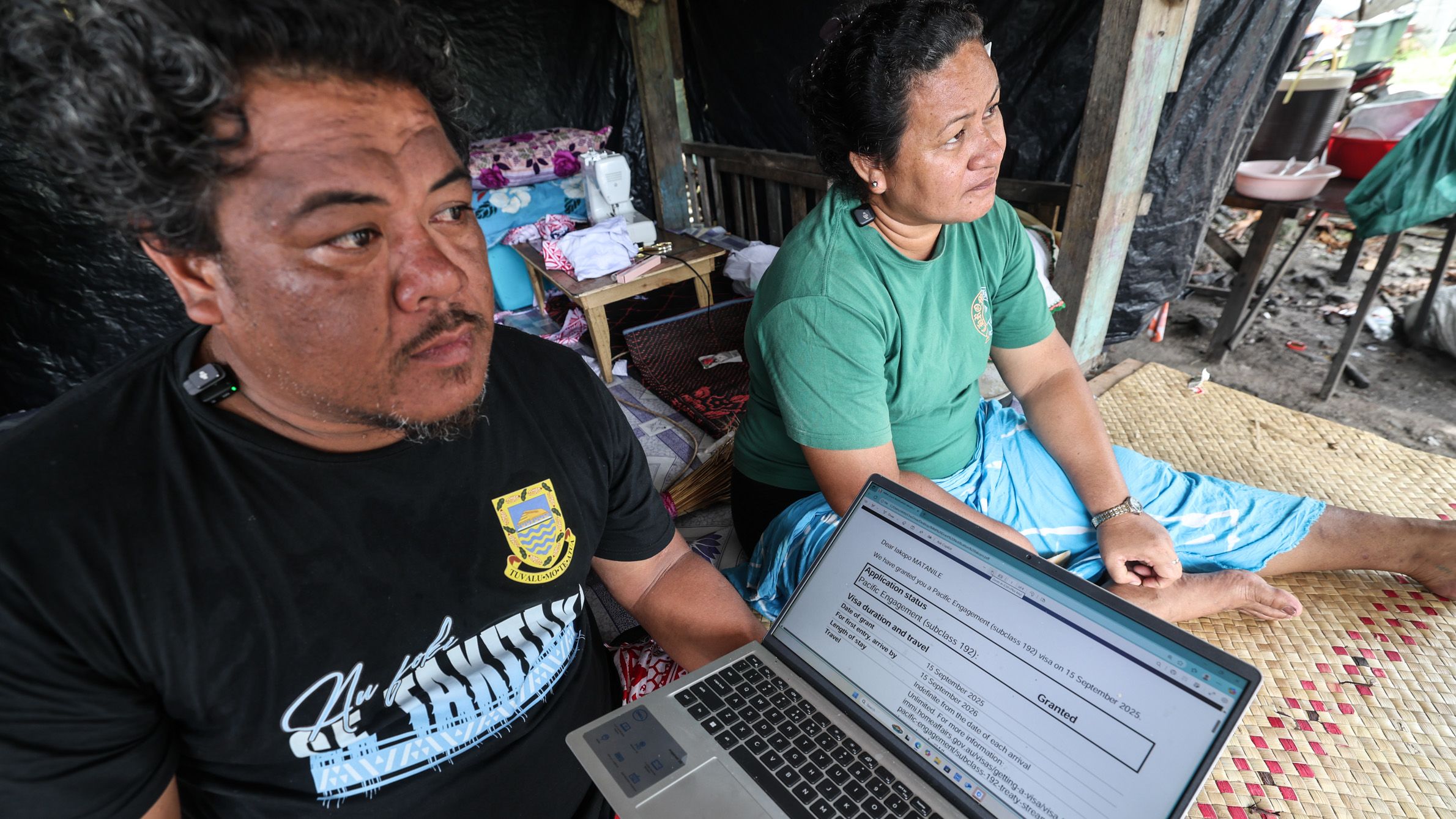
Iakopo Matanile, left, shows off the notification he received that he had won the lottery for a visa allowing him to migrate to Australia. (Photo by Ken Kobayashi)
Iakopo Matanile, left, shows off the notification he received that he had won the lottery for a visa allowing him to migrate to Australia. (Photo by Ken Kobayashi)
For Tuvalu, his departure and that of his fellow lottery winners raises existential concerns which hold resonance for other nations under threat at a time when delegates from around the world are preparing to gather next week in Belem, Brazil for the 30th U.N. Climate Change Conference.
All told, 8,750 people, or more than 80% of Tuvalu’s inhabitants, applied for visas in this year’s lottery draw. Under the Falepili Union Treaty signed in November 2023, Australia has promised to potentially take in every Tuvaluan citizen eventually while continuing to legally recognize Tuvalu’s statehood and sovereignty regardless of what becomes of its islands.


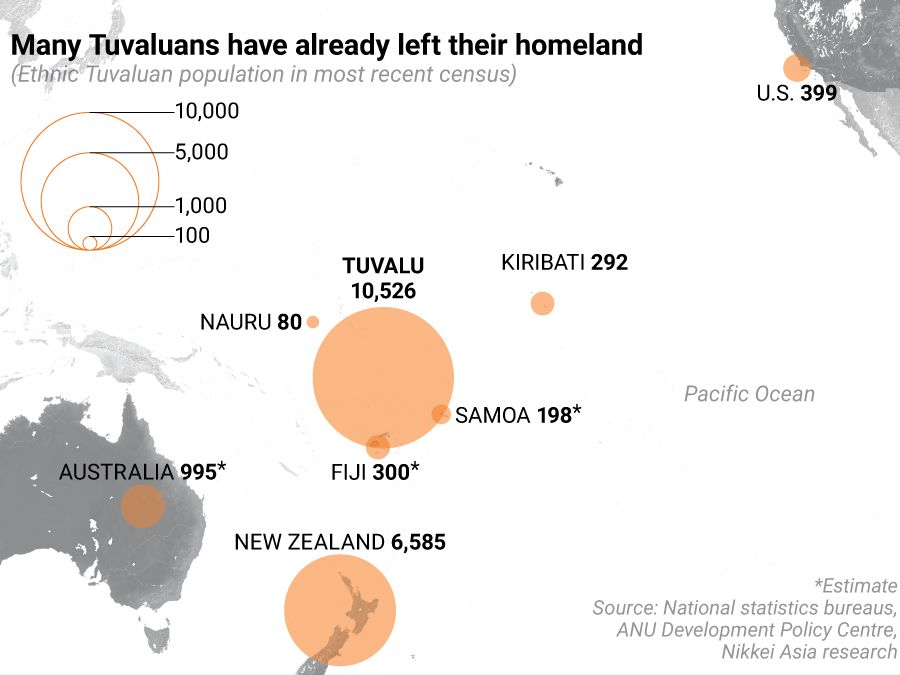
Although Falepili visas will initially be limited to 280 a year, the departure of skilled personnel like Matanile could soon have an impact on Tuvalu’s public services and economy.
Some Tuvaluans also worry that those left behind could be effectively forgotten by the rest of the world, a serious risk for a nation that receives proportionally more development aid in relation to the size of its economy than any other country. According to calculations by the Lowy Institute in Sydney, annual foreign support equates to almost one and a half times Tuvalu’s gross domestic product.
For Australia, the influx of Tuvaluans, while small, comes at a time of tensions around mass immigration and housing scarcity in the country’s urban hubs. But the show of support for Tuvalu embodied by the Falepili migration channel could prove valuable for Canberra’s strategic diplomacy in the Pacific as China ardently courts island states, particularly those like Tuvalu that still maintain diplomatic relations with Taiwan. Under the Falepili treaty, Tuvalu has committed to consulting Australia before entering any security or defense arrangements with other countries.
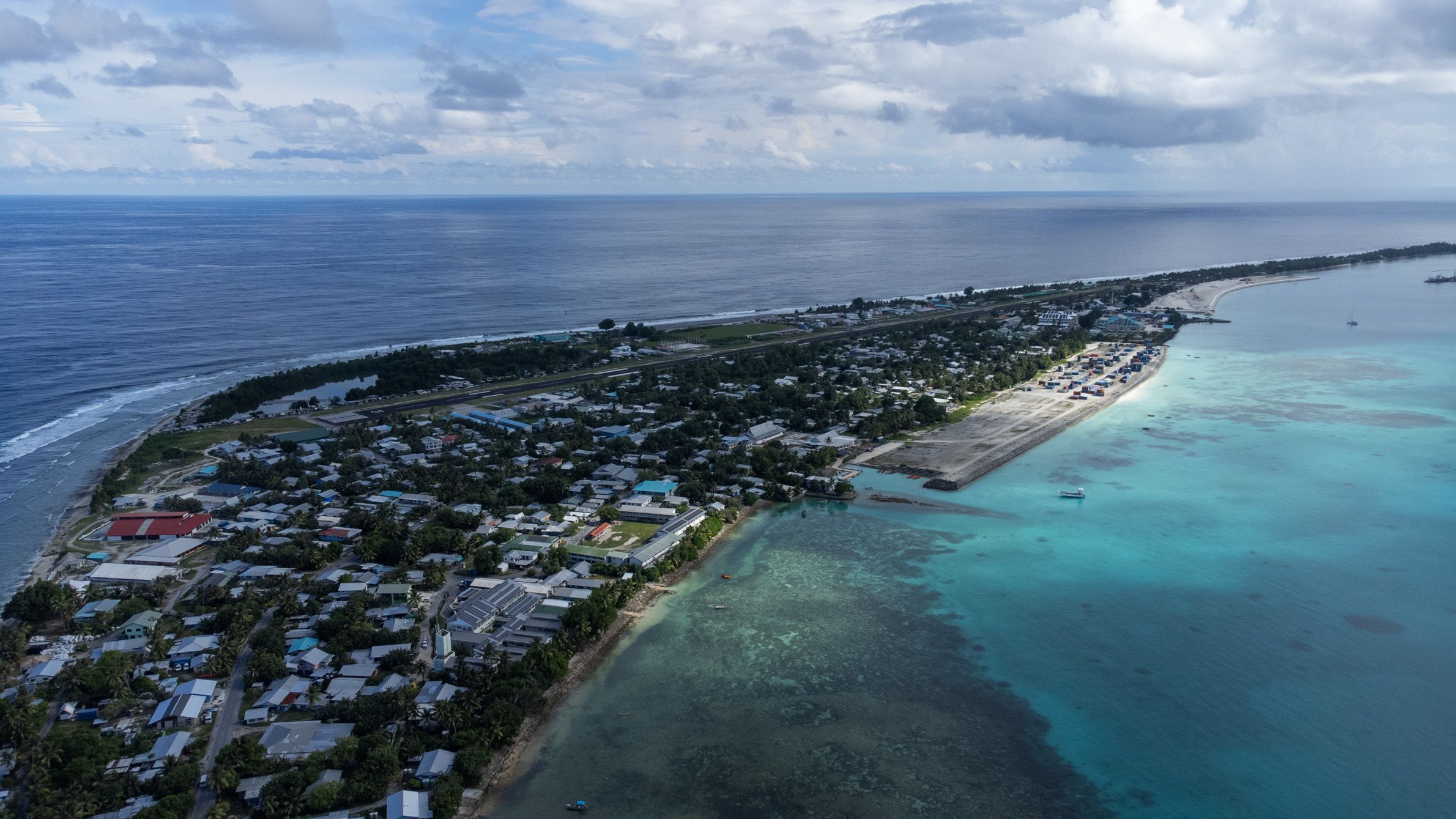
Consisting of nine small islands, much of Tuvalu's 26-square-kilometer surface area sits just 1 or 2 meters above sea level. (Photo by Ken Kobayashi)
Consisting of nine small islands, much of Tuvalu's 26-square-kilometer surface area sits just 1 or 2 meters above sea level. (Photo by Ken Kobayashi)
Consisting of nine small islands, Tuvalu is especially vulnerable to the impact of the rising Pacific as much of its 26-square-kilometer surface area sits just one or two meters above sea level. Recently, Tuvalu has experienced flooding of at least 40 centimeters above high tide as many as 77 days a year. The sea level change team of U.S. space agency NASA has projected that such flooding will become an almost everyday occurrence over the next several decades.
The country’s vulnerability to flooding and its lack of land-based resources have long caused Tuvaluans to try their luck elsewhere.
In the years following World War II, Tuvaluan citizens bought a small island belonging to Fiji and an area of land near Apia, the Samoan capital; both sites attracted hundreds of compatriots to settle. Hundreds of Tuvaluan men have also worked as seamen and fisherman on foreign ships or in the phosphate mines of Nauru. Recently, work as seasonal laborers on farms in New Zealand and Australia has become more common. Tuvalu itself counts on the sale of licenses to foreign ships to fish in its vast exclusive economic zone as its biggest revenue source.
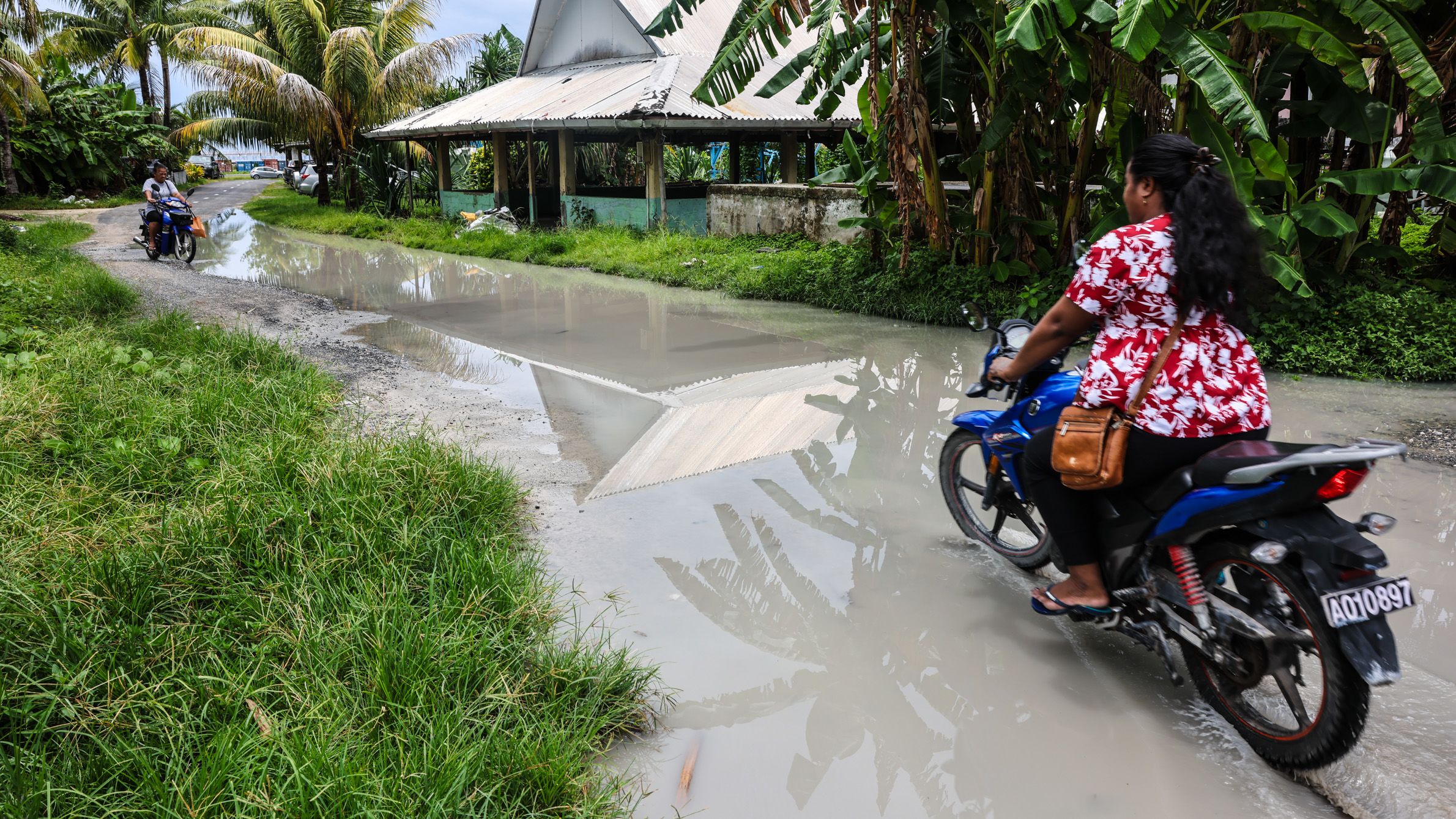
Tuvalu experiences flooding of at least 40 cm above high tide as many as 77 days a year, but scientists predict it will become an almost everyday occurrence. (Photo by Ken Kobayashi)
Tuvalu experiences flooding of at least 40 cm above high tide as many as 77 days a year. (Photo by Ken Kobayashi)
"The island is gonna go down," said Funafuti resident Amalei Pele, 47. She applied for this year’s visa lottery but was not among the first 82 winners notified. “I don't want to die under the water.”
In 2002, then-Prime Minister Koloa Talake retained overseas legal counsel to look at suing Australia and other developed nations at the International Court of Justice over their roles as polluters driving climate change.
But Tuvalu has also long eyed the vast continent of Australia as a potential refuge. A few years after Talake’s threat, Tuvalu seized on Australia’s search for island nations willing to accommodate its asylum seekers to propose a reciprocal arrangement under which Canberra would in exchange accept Tuvaluan immigrants, but to no avail.

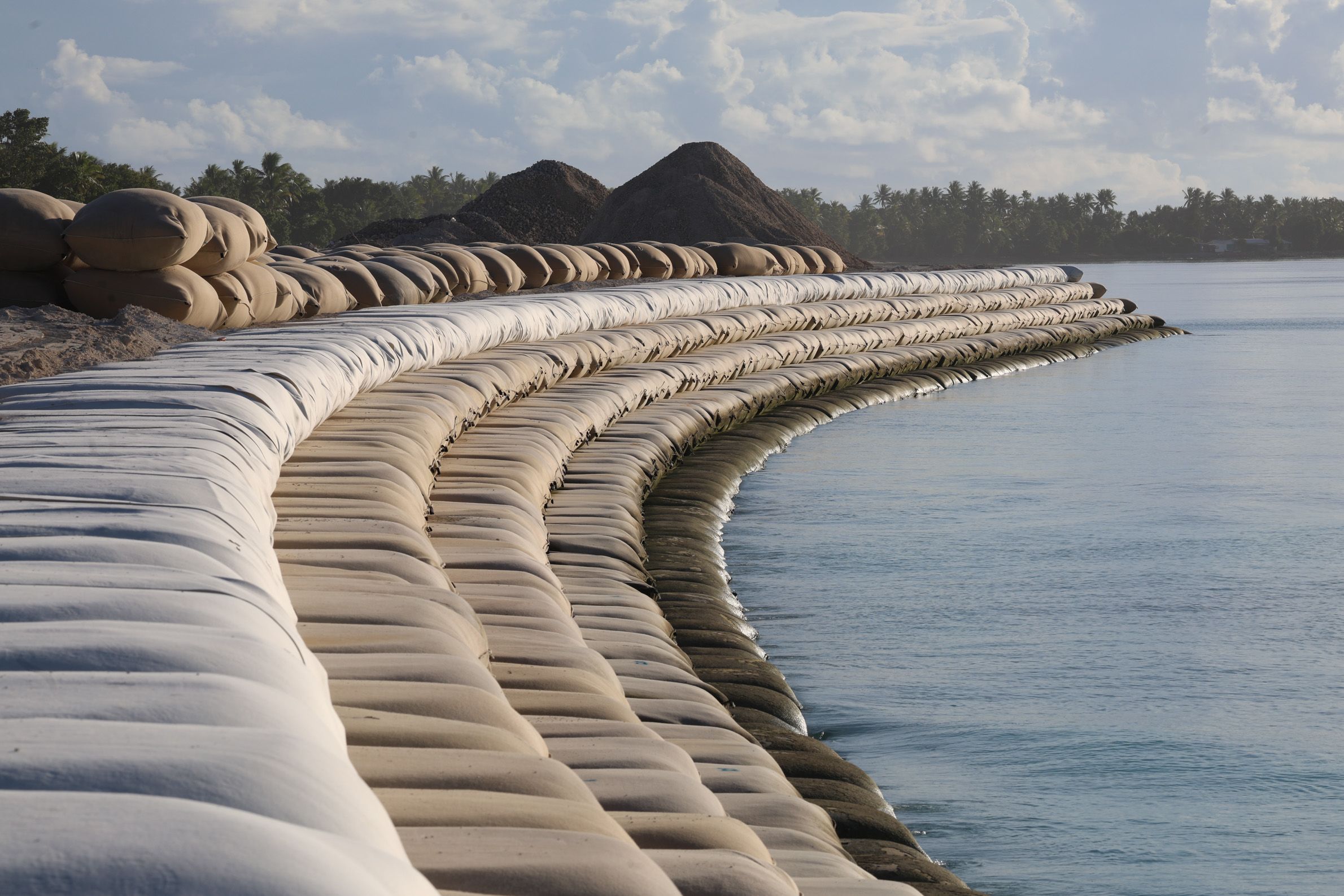
The Tuvalu Coastal Adaptation Project, backed by Australia, seeks to expand the island nation’s land mass. (Photo by Ken Kobayashi)
The Tuvalu Coastal Adaptation Project, backed by Australia, seeks to expand the island nation’s land mass. (Photo by Ken Kobayashi)
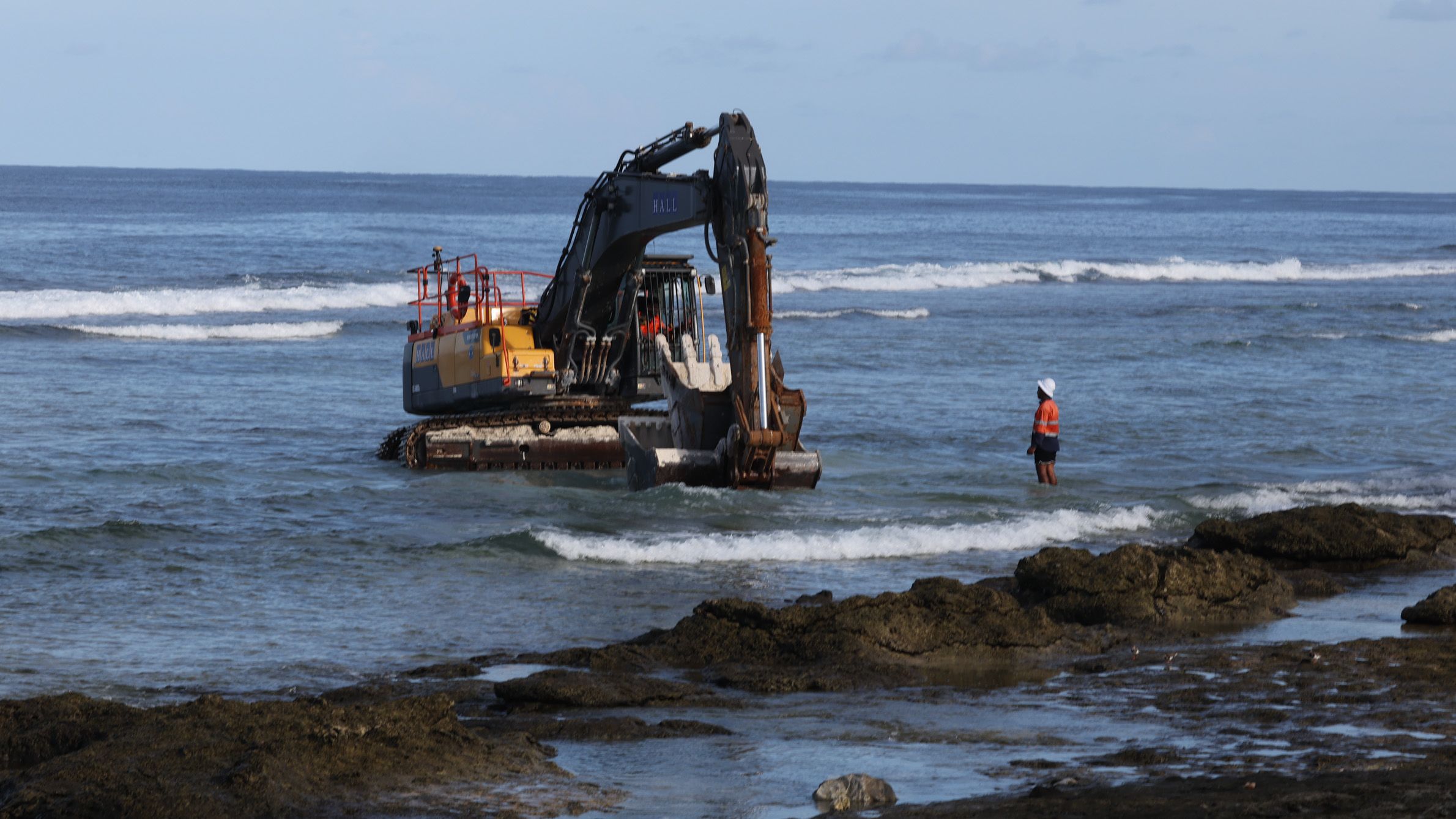
Reclamation for the Tuvalu Coastal Adaptation Project in October 2025. (Photo by Ken Kobayashi)
Reclamation for the Tuvalu Coastal Adaptation Project in October 2025. (Photo by Ken Kobayashi)
What finally prodded Australia to create a migration pathway for Tuvalu’s populace -- the smallest of all the U.N.’s 193 member states -- was China; Beijing would appear to have no inclination to make a comparable offer to would-be climate migrants.
But over the last decade, China has lured away many of Taiwan’s former diplomatic allies in the Pacific -- including the Solomon Islands, Kiribati and Nauru -- with pledges of millions of dollars in aid and investment. This has raised concerns among Australia and its Western allies that Beijing could seek to establish military or intelligence outposts in the often-neglected region.
As a result, Stephen Howes, director of the Development Policy Centre at Australian National University in Canberra, said that in respect of the Falepili Union, “The real driver for Australia is security.”
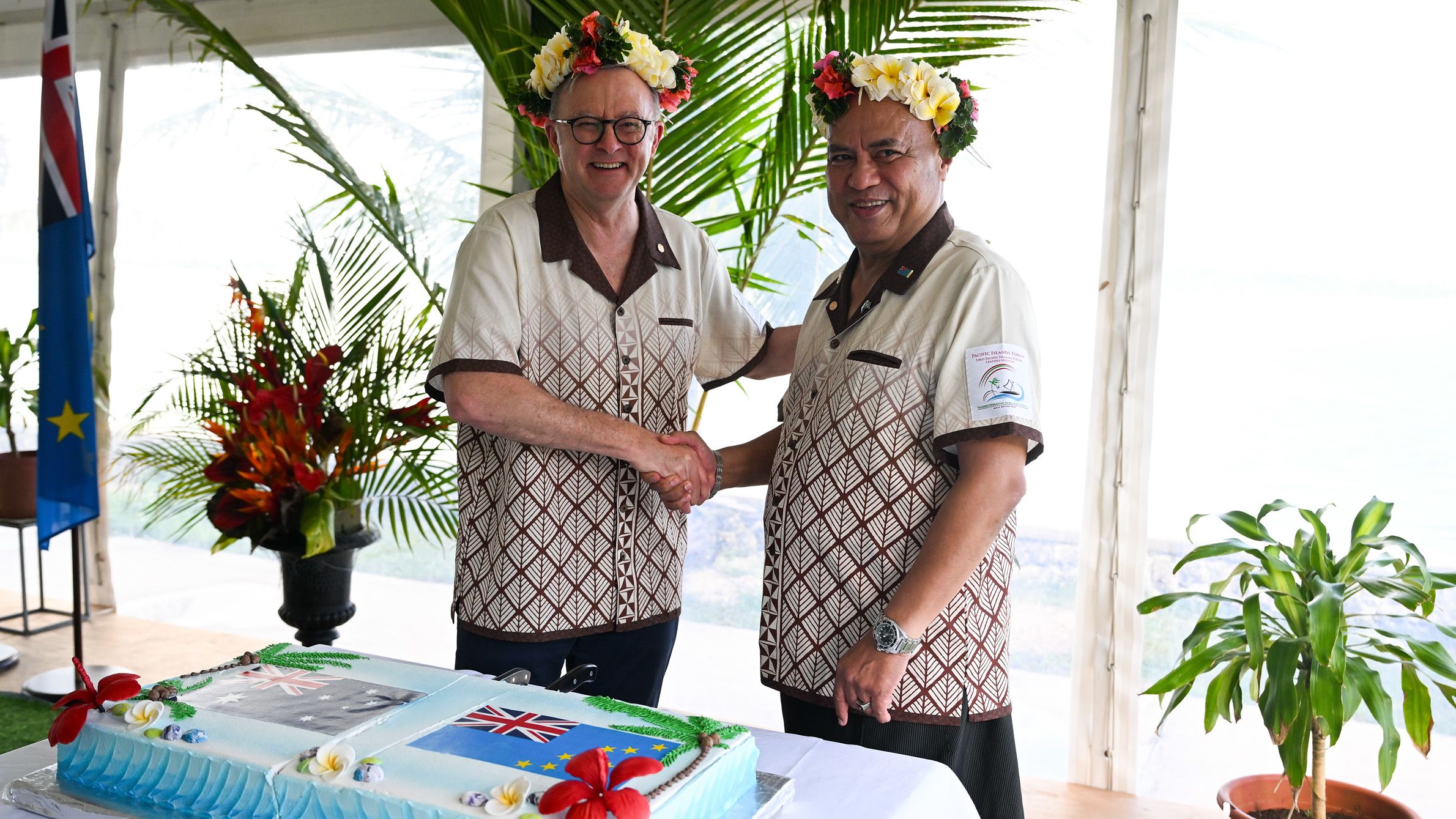
Australian Prime Minister Anthony Albanese, left, with Tuvaluan Prime Minister Feleti Teo in Tonga in August 2024 after signing agreements to bring the Falepili Union into force. (AAP)
Australian Prime Minister Anthony Albanese, left, with Tuvaluan Prime Minister Feleti Teo in 2024 after signing agreements to bring the Falepili Union into force. (AAP)
“In return for getting this special deal on migration, which Tuvalu wanted, they've had to agree to give Australia a sort of veto power on its security arrangements with other countries,” Howes said. “That's clearly aimed at China.”
While Tuvaluan Prime Minister Feleti Teo previously raised concerns about how his predecessor, Kausea Natano, handled the process that led to the Falepili Union Treaty, last month he called the agreement “an unprecedented achievement” in an interview in Funafuti with Nikkei Asia.


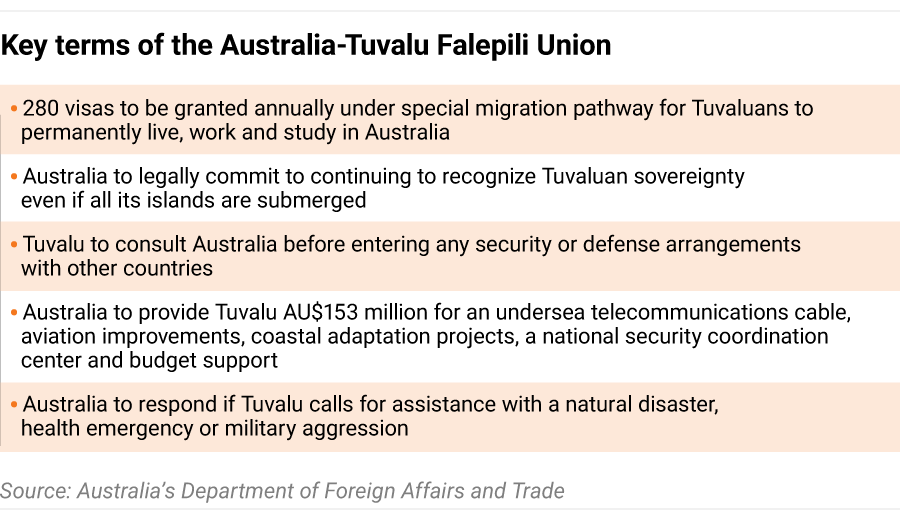
“For Australia to commit to a legal document recognizing Tuvalu’s statehood, despite the impact of climate change, is a significant step forward,” he said. Taiwan is expected to follow suit later this month.
The prime minister also highlighted financial support Canberra pledged in the Falepili agreement for the Tuvalu Coastal Adaptation Project to expand the country’s land area, an effort he called “a national investment in our future, a tangible statement of survival and sovereignty.”
In Teo’s view, the Falepili visa program is a crucial lifeline for his nation’s people.
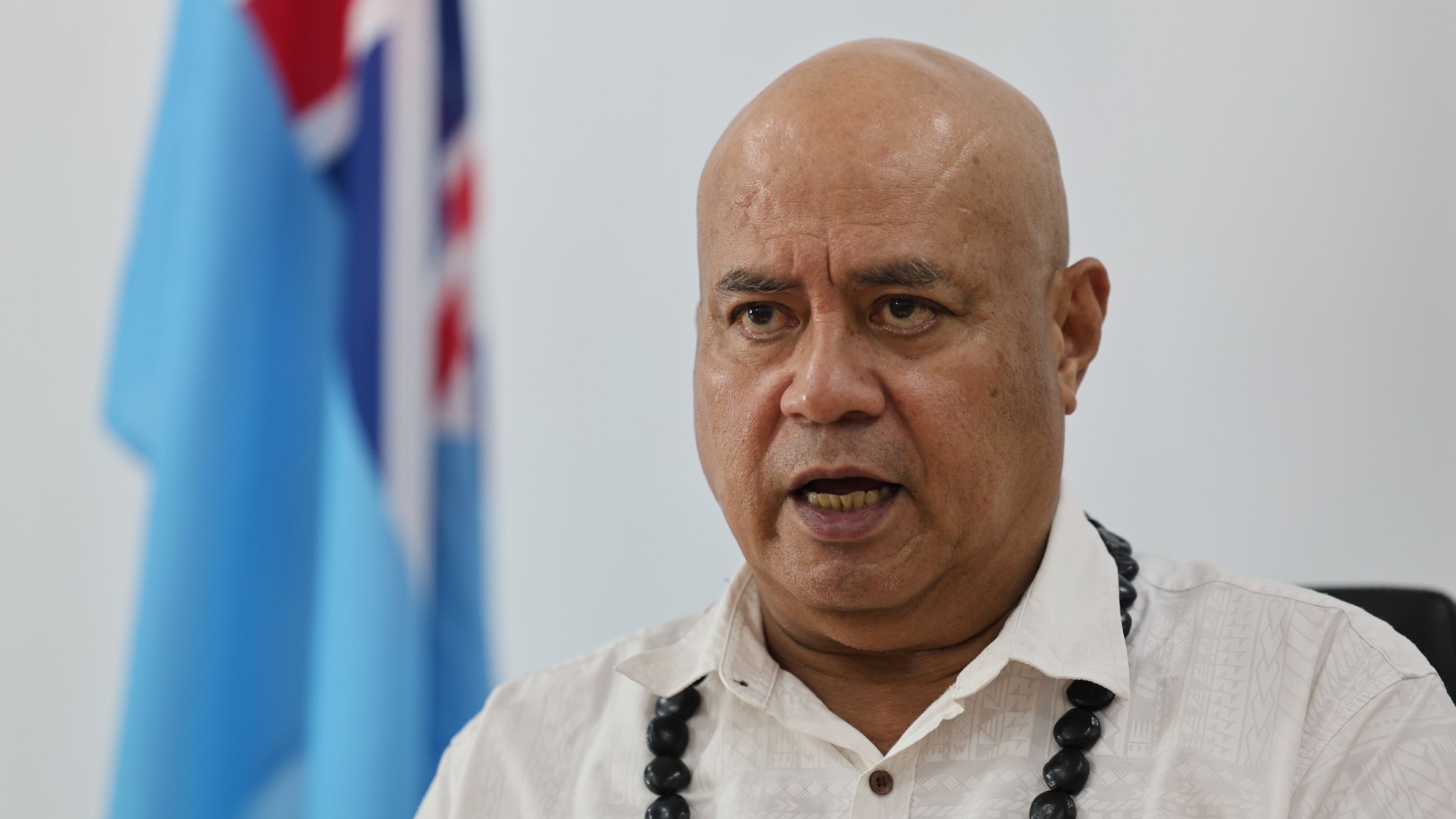
Tuvaluan Prime Minister Feleti Teo calls the Falepili Union Treaty “an unprecedented achievement.” (Photo by Ken Kobayashi)
Tuvaluan Prime Minister Feleti Teo calls the Falepili Union Treaty “an unprecedented achievement.” (Photo by Ken Kobayashi)
“Nature can overcome us,” Teo told Nikkei. “We cannot stop migration … but all we can do through the Falepili … [is] to provide those people who travel to other countries with dignity. … They will not be abused or mistreated in Australia.”
Under the treaty, Australia has promised to provide migrants with access to education, health care and other social welfare benefits that local citizens enjoy -- including a national minimum wage far above usual Tuvaluan pay levels.
Tevina Kammari, who staffs a hotel bar in Funafuti, was among this year’s first visa lottery winners. She plans to move with her husband, a supervisor at one of the capital’s largest retailers, to Melbourne where they look forward to legally mandated pay of at least 24.95 Australian dollars ($16.20) per hour. That compares with their current wages of AU$4 to AU$6 an hour.
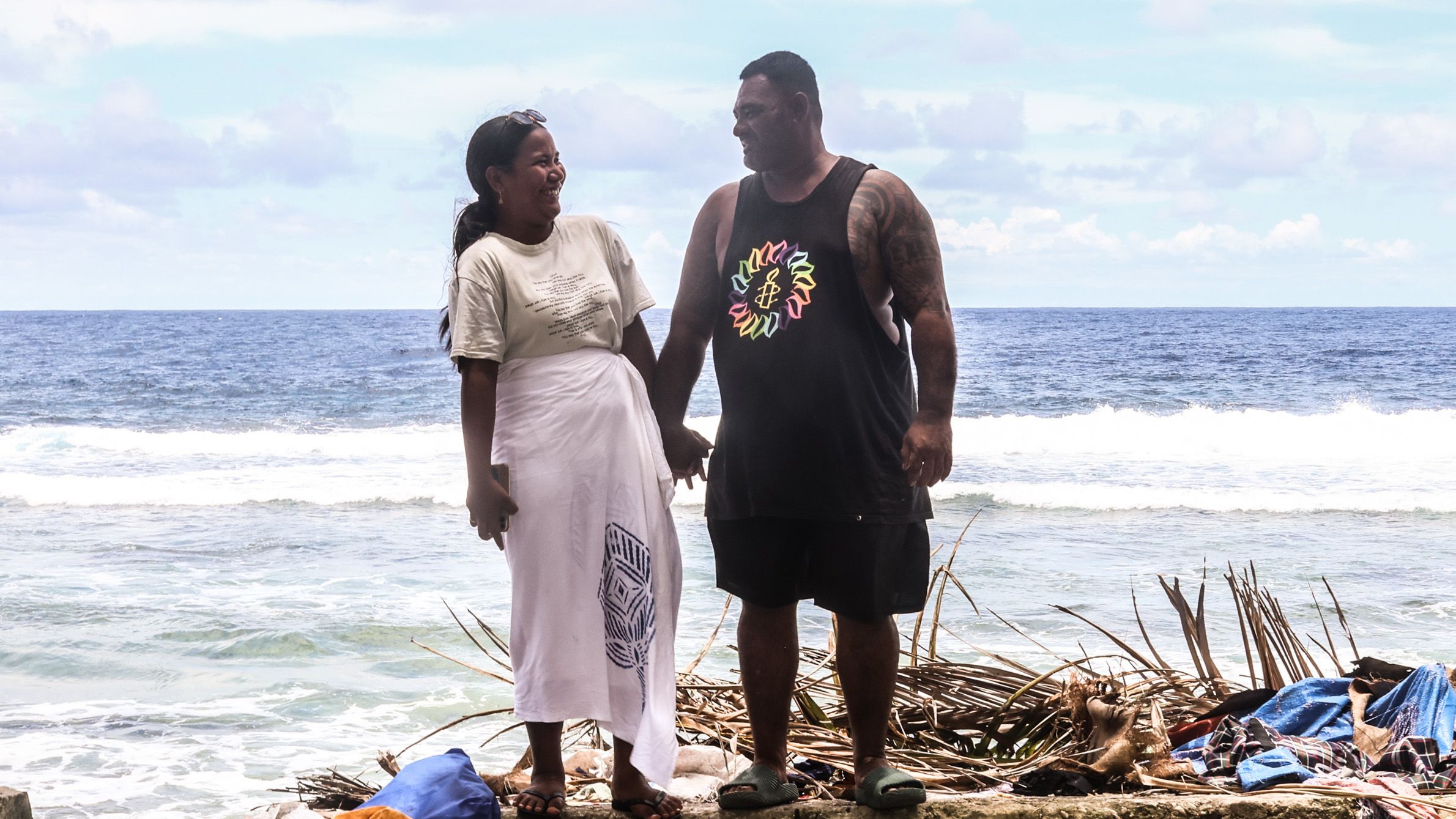
Tevina Kammari, left, and her husband Sakau Nataua expect to earn far higher salaries after they move to Melbourne next year than they do in Tuvalu. (Photo by Ken Kobayashi)
Tevina Kammari, left, and her husband Sakau Nataua expect to earn far higher salaries after they move to Melbourne. (Photo by Ken Kobayashi)
“I’m so happy,” said Kammari, 21. “I want to satisfy the needs and wants of my family. … There's just not enough money.”
Family, in the form of a 2-year-old child, was also Ainoama Kaitu’s motivation to apply for a Falepili visa to escape Tuvalu’s rising seas. She plans to reenter the lottery again next year if she is not accepted in this year's group.
“Looking in the future for my daughter here in Tuvalu is kind of sad,” said the 28-year-old. “She won’t be able to see … how Tuvalu used to be in the past.”


"March for Australia" demonstrators in Sydney on Aug. 31: Thousands rallied around the country to express their hostility to immigration. (Reuters)
"March for Australia" demonstrators in Sydney on Aug. 31: Thousands rallied around the country to express their hostility to immigration. (Reuters)
Meanwhile, Iakopo Matanile has pushed back his family’s departure for Brisbane by a month or two. They have until next September to make the move under the terms of their Falepili visa. But news of large anti-immigration rallies in Australia in August and October have given him some second thoughts about the community he is about to enter. “What if they don’t want us?” Matanile said.
Tuvaluan migrants will at least be able to fall back on support from countrymen who made the journey to Australia earlier.
Melbourne resident Niuelesolo Boland, 34, is preparing to welcome a cousin who won a Falepili visa to temporarily stay at his home while he gets settled.

Tuvaluan immigrant Niuelesolo Boland is preparing to temporarily welcome a cousin into his Melbourne home while urging Australia to provide more support. (Photo by Asanka Brendon Ratnayake)
Tuvaluan immigrant Niuelesolo Boland is preparing to temporarily welcome a cousin into his Melbourne home. (Photo by Asanka Brendon Ratnayake)
“Eventually it will be the diaspora that will have to take on the burden” of supporting the transition of migrants, said Boland, a construction worker who arrived in Australia in 2001 and serves as president of community group Kaiga Tuvalu Victoria.
Back in Funafuti, Fakavae Taomia, a former Tuvaluan senior civil servant now working with the World Bank, worries about how things will get done when so many young people are leaving or trying to. His son, 28, was among this year’s early Falepili winners.
“We normally rely on the youth to do things at the community level, like building a house, doing the fishing, doing the hard work,” said Taomia, 59. “So [regarding] the impact on the labor force of tomorrow … it's important for the government also to have a trace study.”
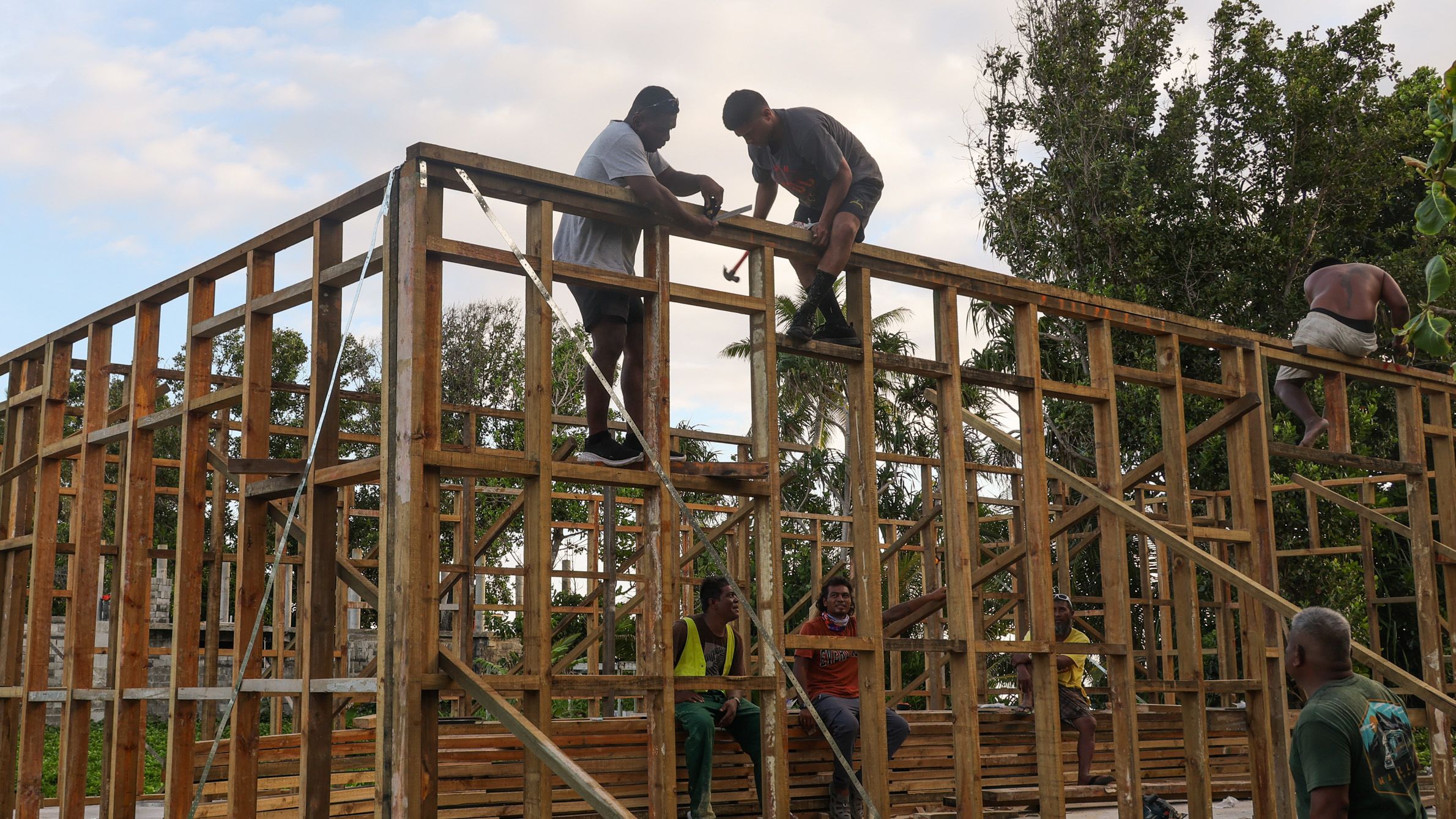
The emigration of young able-bodied workers could impact homebuilding and other labor-intensive activities in Tuvalu. (Photo by Ken Kobayashi)
The emigration of young able-bodied workers could impact homebuilding and other labor-intensive activities in Tuvalu. (Photo by Ken Kobayashi)
Immigration officer Naomi Hosea has an especially direct view of the exodus as she alternates between office duties issuing passports for outbound migrants and manning a check post at Funafuti International Airport.
"I'm happy [for them] and on the other side I'm sad because I don't know when we are going to meet again or see them again,” she said. “It's mixed feelings."
If departees want to see Hosea again, they will probably have to fly back to Funafuti.
“I want to be here,” she said. “Elsewhere, I have to go get a cab and have to spend money for transportation, even to see a doctor. It's really different compared to our life here. Everything is free … [and] there's nothing to worry about.”
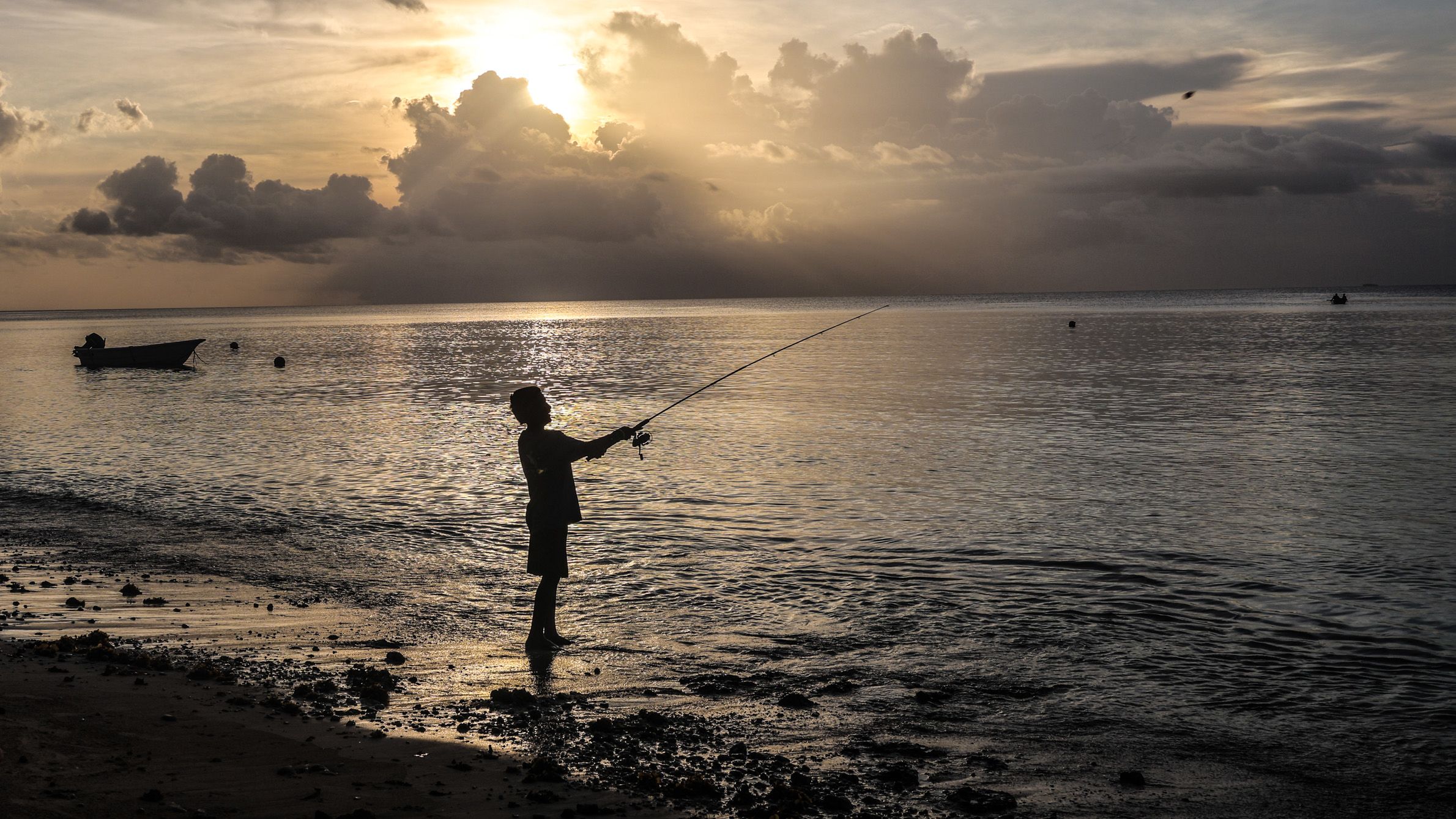
Sunset in Tuvalu: Hundreds of islanders have left to work as seamen and fisherman on foreign ships. (Photo by Ken Kobayashi)
Sunset in Tuvalu: Hundreds of islanders have left to work as seamen and fisherman on foreign ships. (Photo by Ken Kobayashi)
Additional reporting: Sophie Mak in Sydney
Photographer: Ken Kobayashi, Asanka Brendon Ratnayake
Editor: Zach Coleman
Graphics: MinJung Kim, Hidechika Nishijima, Hiroko Aida, Yoshiko Kawano