
Inside Taiwan's fight to protect its vital undersea cables
Taipei fears key communication infrastructure is vulnerable to Chinese interference
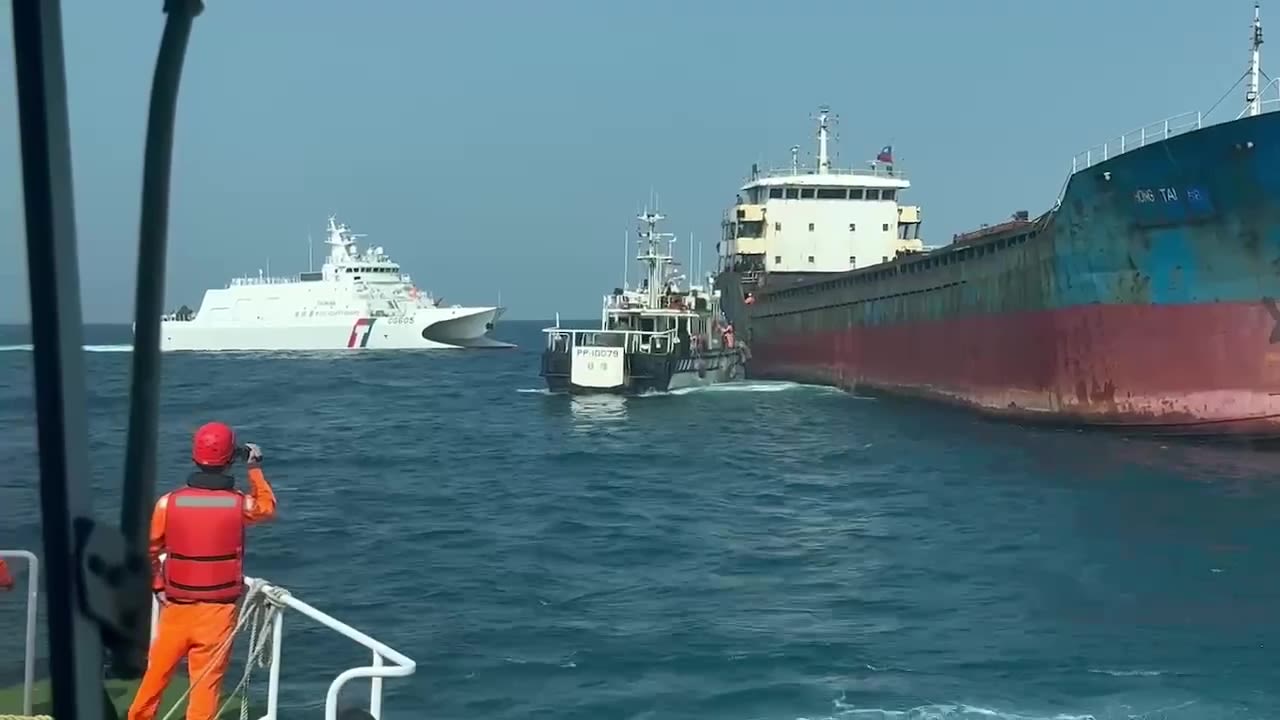

Ruan Jhong-Cing, chief officer of the Taiwanese coast guard patrol boat PP-10079, recalled battling gale-force winds and towering waves on a chilly night in February when his crew finally spotted a suspicious cargo ship that had been lingering in the outer waters off the city of Tainan for several days.
"We warned the ship several times by marine radio that subsea cables are right underneath the waters and ordered it to leave," Ruan told Nikkei Asia in the first public account of the incident.
The patrol fleet reached the area at 2:30 a.m. on Feb. 25 and, amid crashing waves, identified the cargo ship as the Hong Tai 168, even though the vessel was registered as the Hong Tai 58. This discovery put the patrol crew on high alert, according to Ruan. Some 30 minutes later, reports came in that signals from subsea cables in the same waters had been cut off, coinciding with the moment the cargo ship weighed anchor.
"Our crew tried several times, but the weather and distance made it too dangerous to jump aboard," Ruan said. His team was eventually able to board and inspect the ship and, with the support of a larger coast guard vessel, escorted it to port by noon the following day.

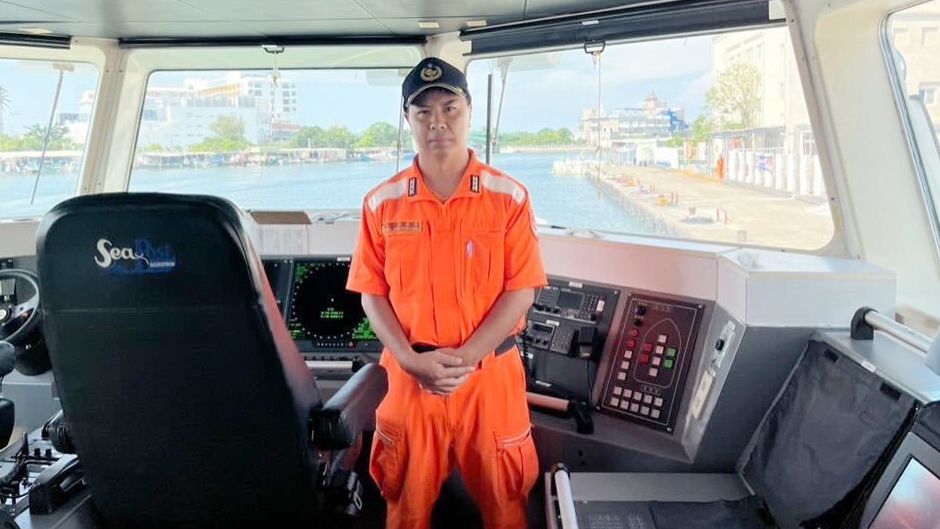
Ruan Jhong-Cing, the chief officer of Taiwanese coast guard patrol boat PP-10079 (Photo courtesy of the Taiwan Coast Guard Administration)
Ruan Jhong-Cing, the chief officer of Taiwanese coast guard patrol boat PP-10079 (Photo courtesy of the Taiwan Coast Guard Administration)
The actions of Ruan and his crew led to the first-ever indictment by Taiwanese prosecutors in a case involving damage to subsea cables. Although the Hong Tai 58 was registered in the West African nation of Togo, its captain and crew were Chinese nationals. The captain, whose surname is Wang, was convicted in June of damaging submarine cables and sentenced to three years in prison. No evidence has been found that Wang was directly linked to the Chinese government or ordered by Beijing to cut the cables.
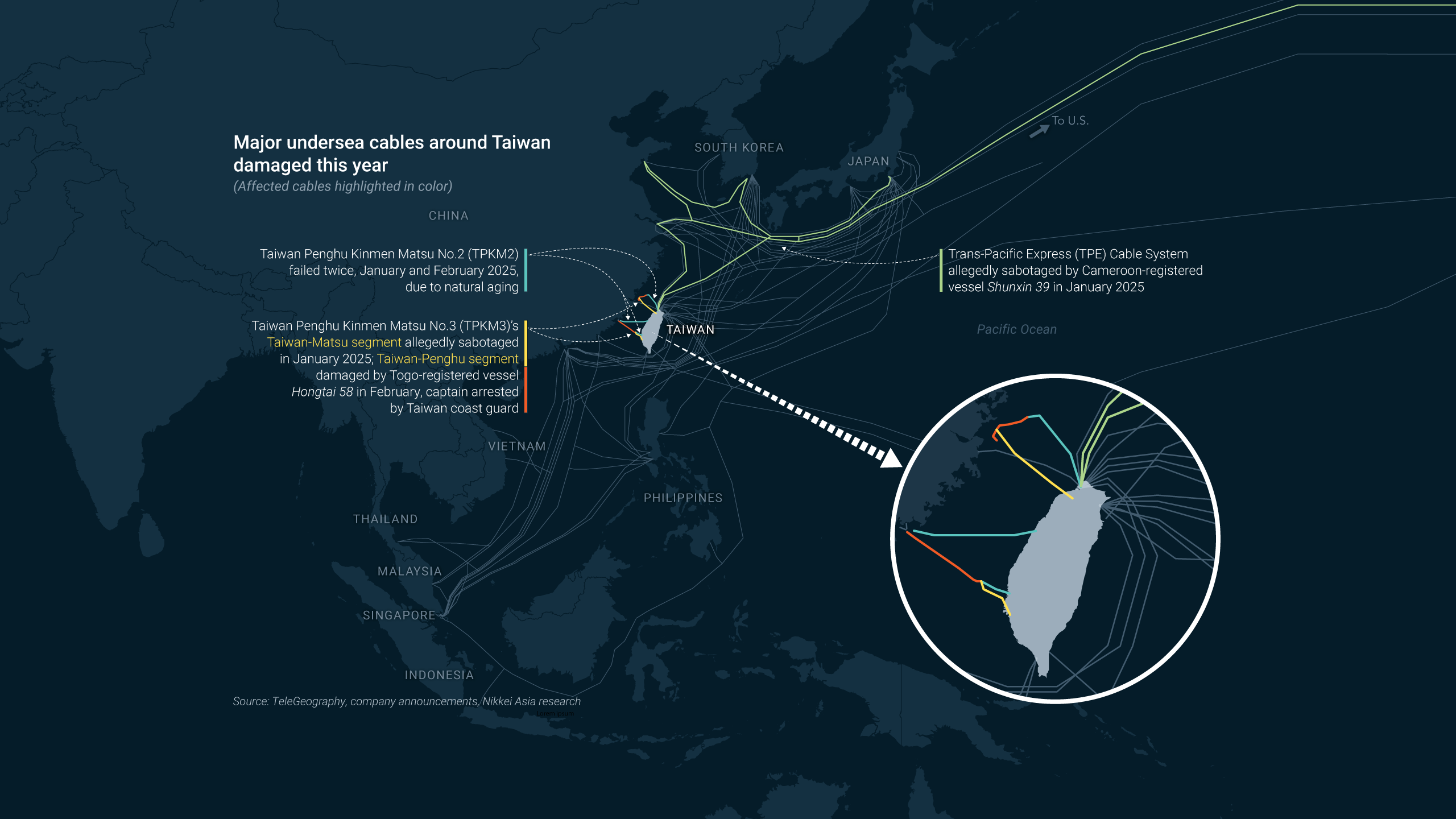
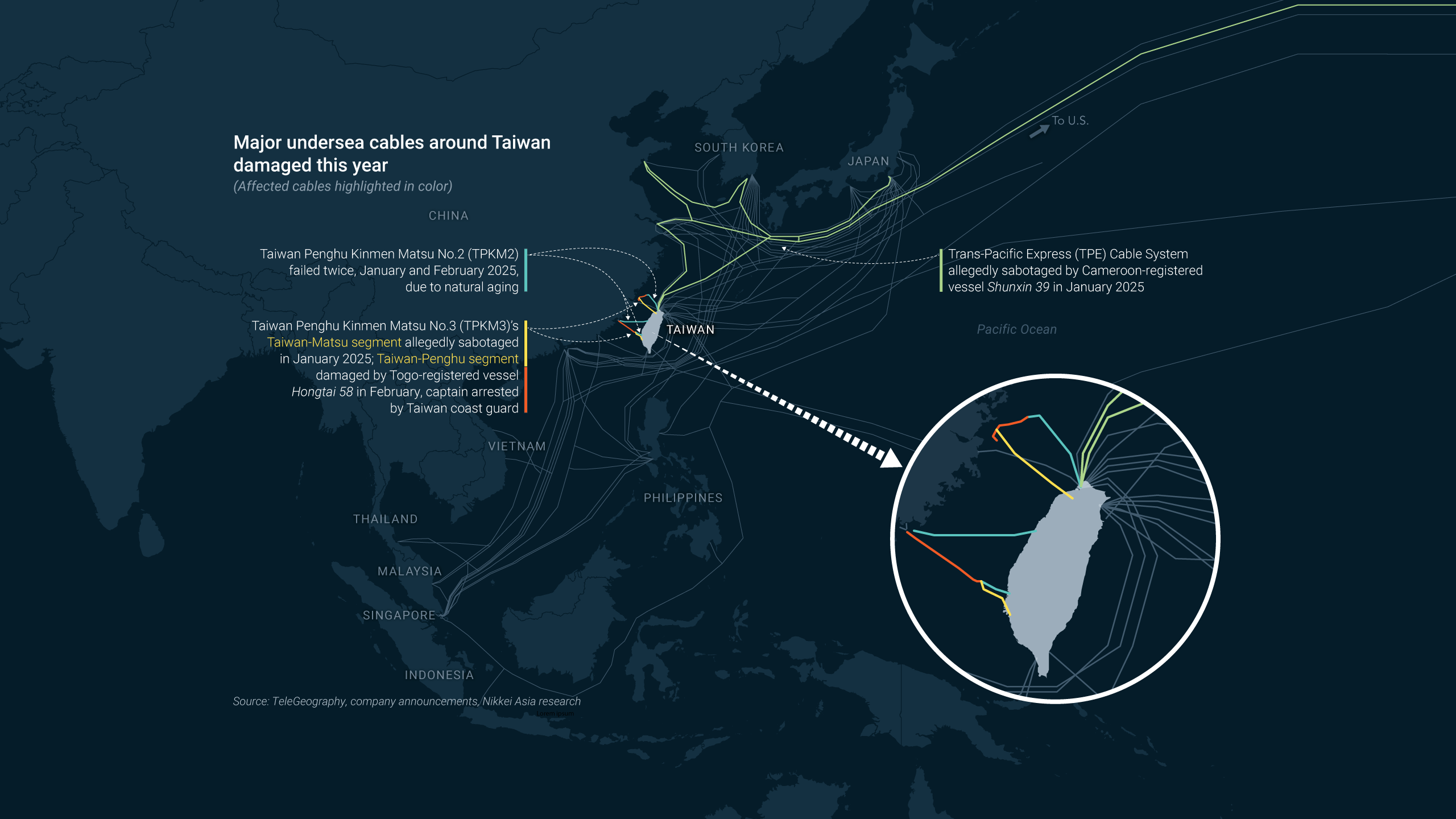
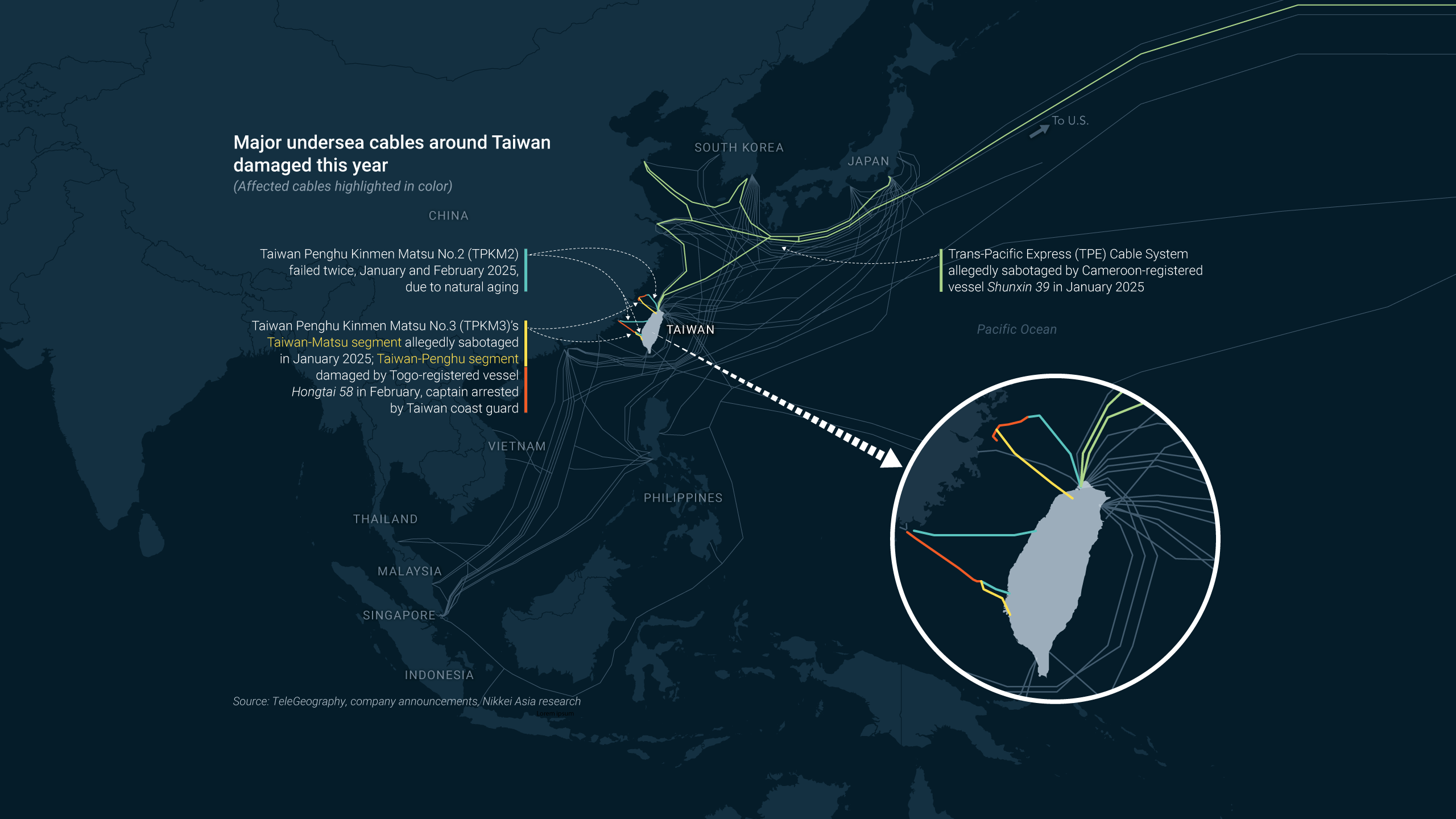
This was far from a one-off incident, however. Taiwan has reported an unprecedented number of subsea cable disruptions in the first few months of this year. Although some damage was attributed to natural aging, the surge has sparked mounting concerns that Beijing could use fishing and cargo ships as cover for gray-zone operations aimed at hitting Taiwan's critical communications infrastructure. Such activities are difficult to detect and pose a growing threat to the island's economic and communications security.
"The gray-zone activities are serious because these threats could be Trojan horses," Hsieh Ching-Chin, deputy director general of the Taiwan Coast Guard Administration, told Nikkei, adding that the threat of Chinese gray-zone moves is rising.
"We cannot rule out the possibility that, even if these vessels are registered for commercial or fishing use, they could still be instructed by the Chinese Communist Party to support potential military operations, including blockades, disruption of digital infrastructure, or battlefield mapping to better understand the waters for future military activities," Hsieh said.
Taiwan is stepping up efforts to protect its subsea cables, but the challenges are steep.

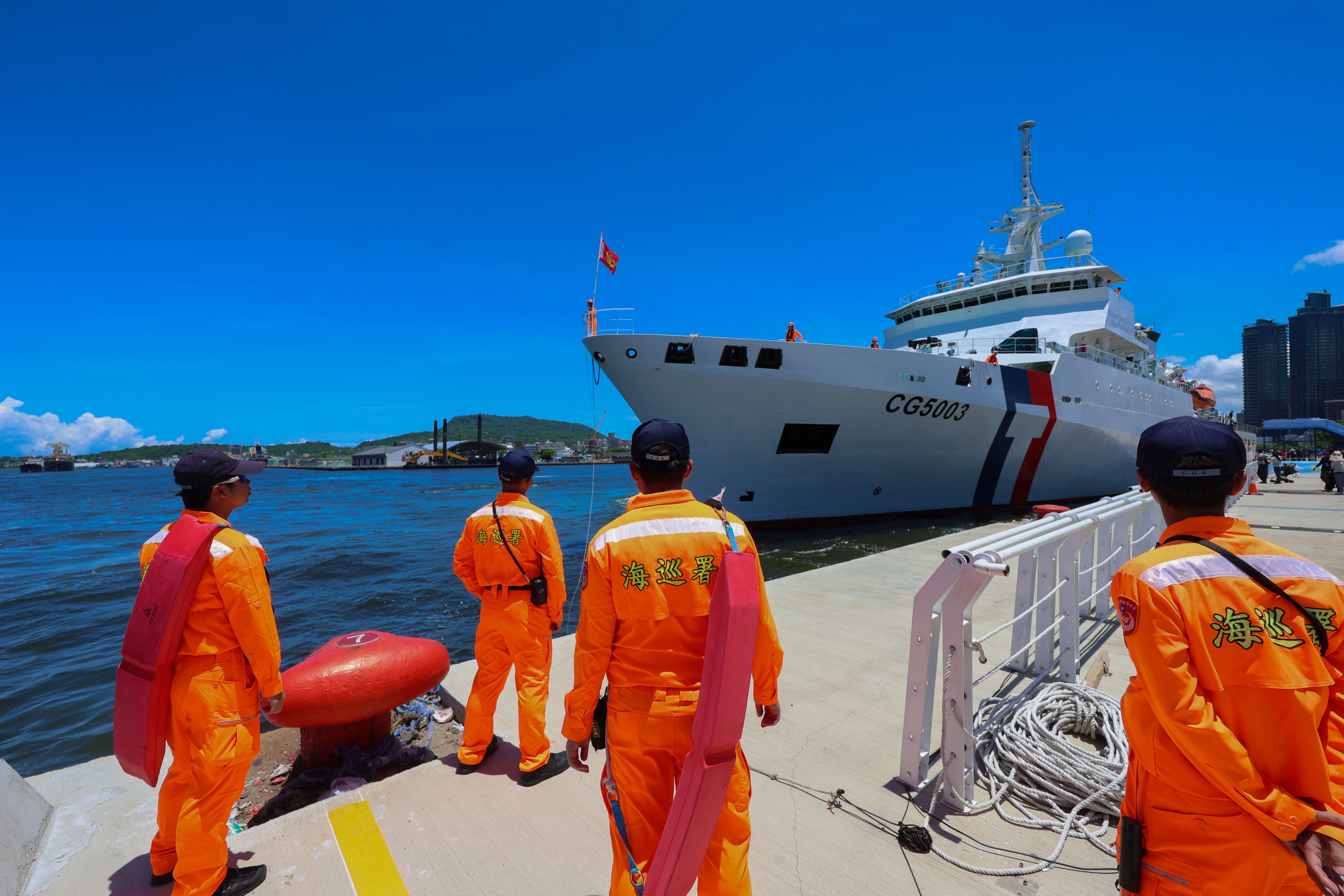
Taiwan, an island democracy surrounded by the Pacific Ocean to the east and the Taiwan Strait to the west, is a key Asian tech and chip production hub. Its location in the so-called first island chain -- which also includes the Kuril Islands, the Japanese archipelago, the northern Philippines and Borneo and is seen by some as a geographic bulwark against Chinese military expansion -- give Taiwan further strategic importance to Western democracies. Beijing, however, claims self-ruled Taiwan as part of its territory and has not ruled out taking it by force.
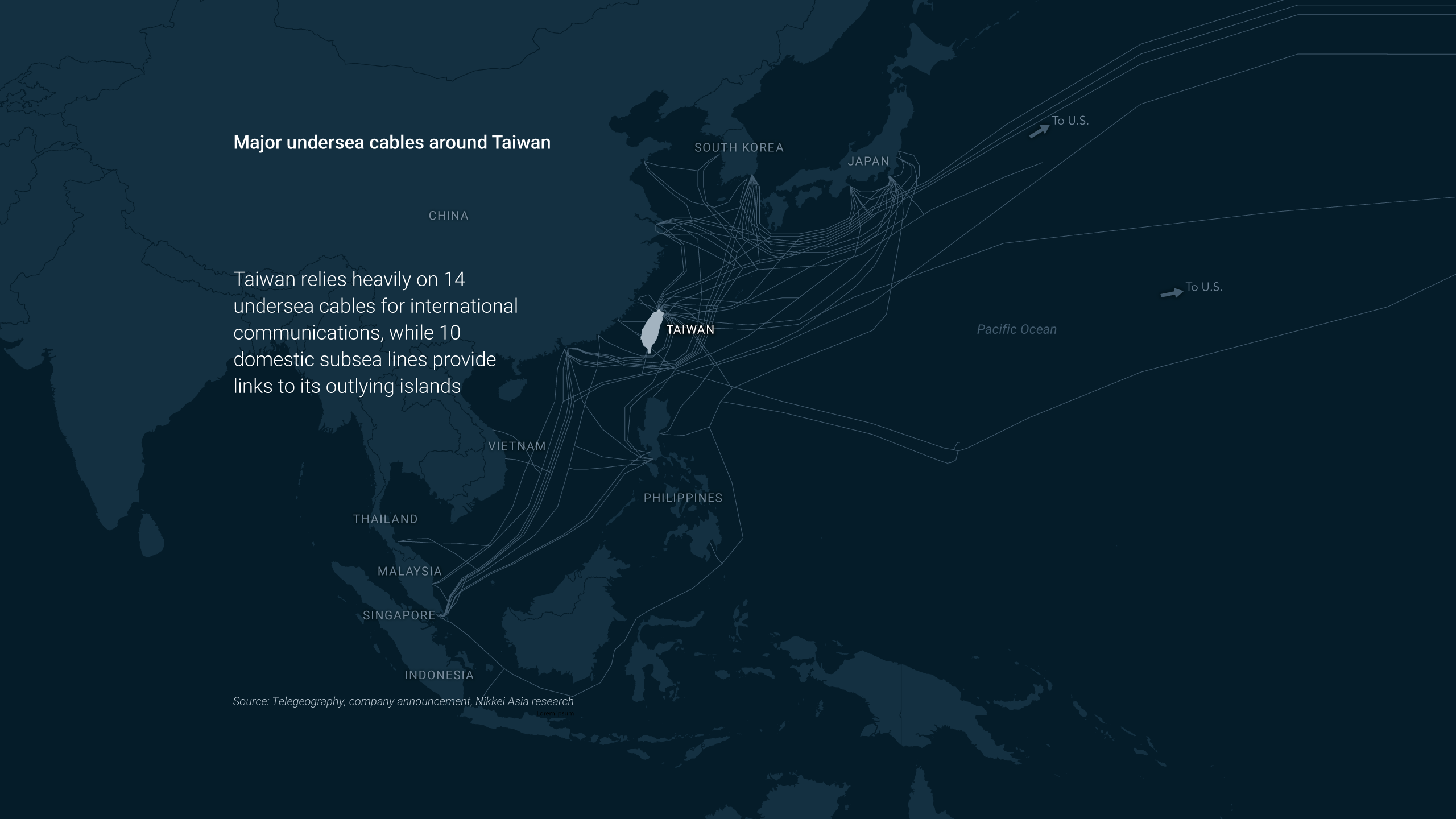
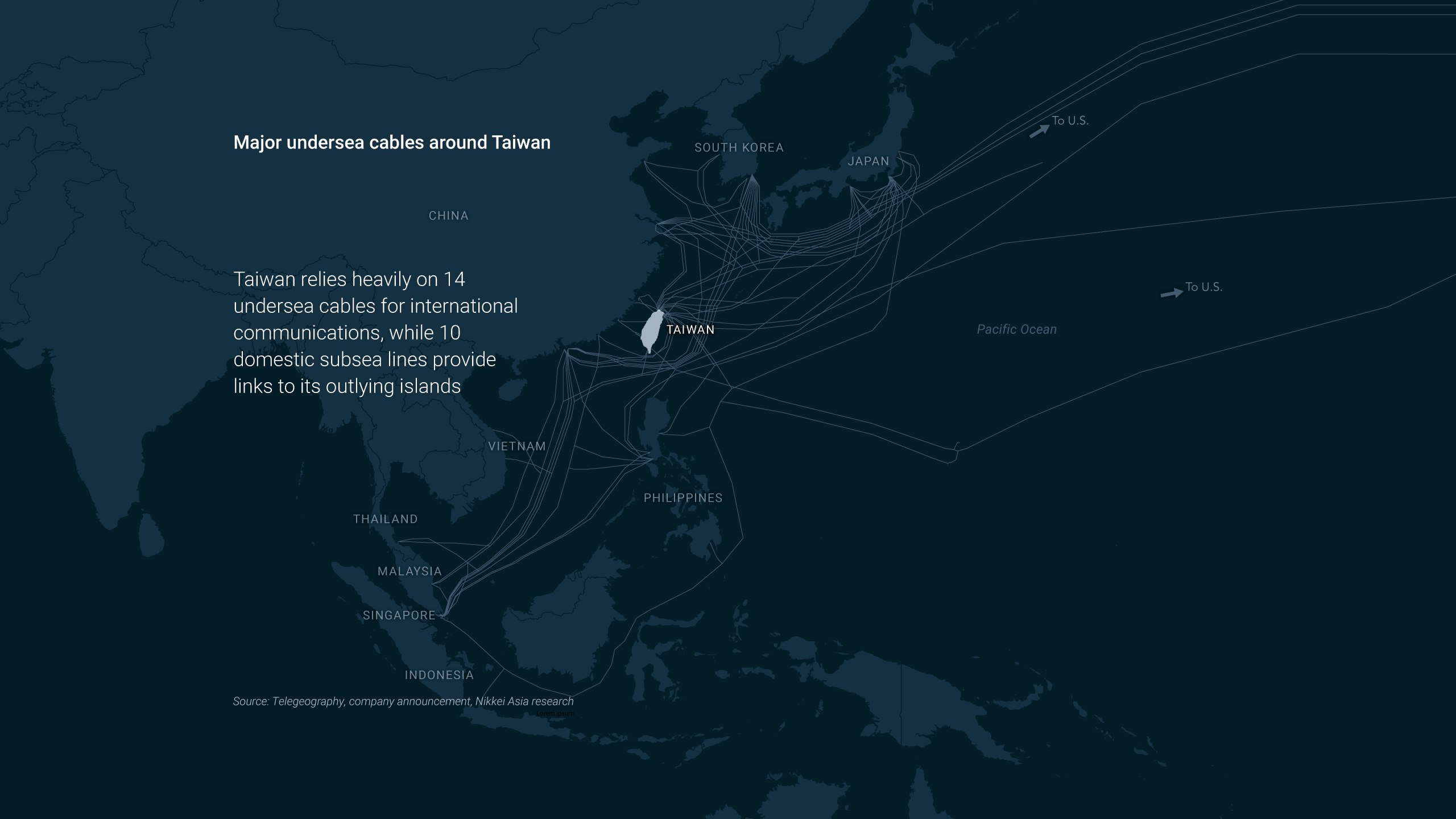
Fourteen submarine cables carry the bulk of Taiwan's international communications, with 10 lines providing links to its outlying islands, according to government data. Growing tensions between Taipei and Beijing have left this vital infrastructure increasingly vulnerable.


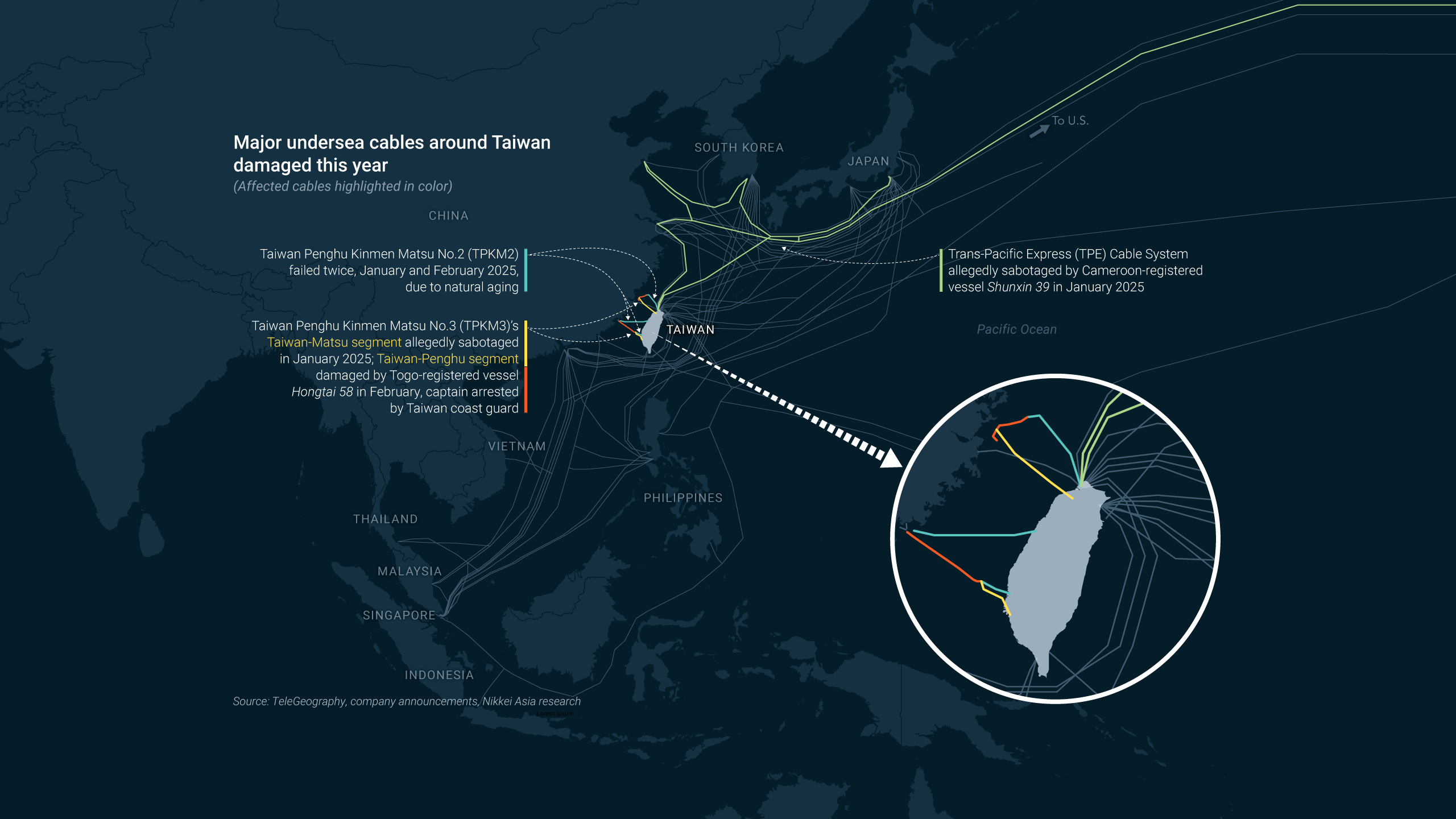
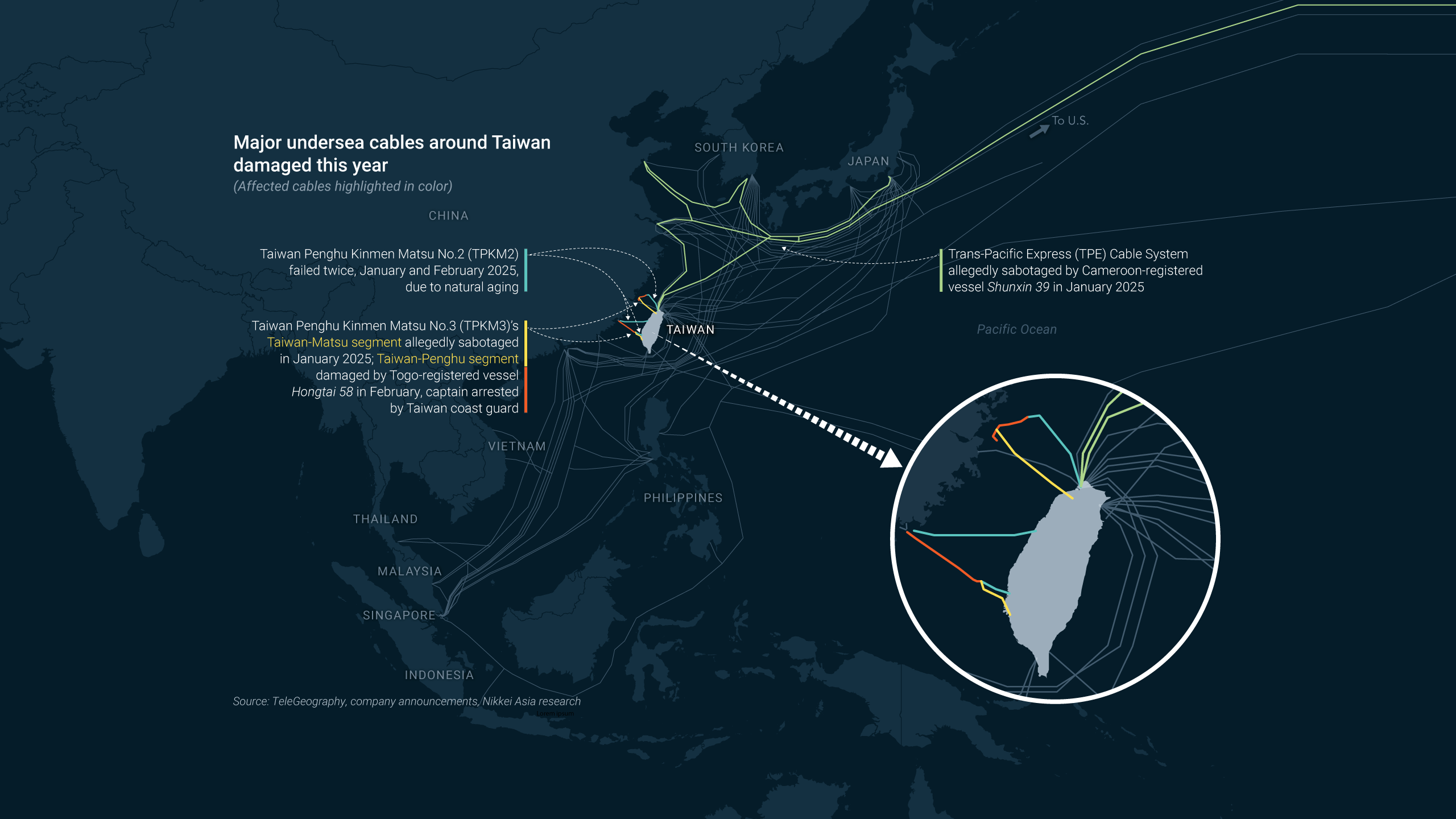
"The internet lifeline to an island like Taiwan is submarine cables," Herming Chiueh, former deputy minister of digital affairs and professor of Hsinchu-based National Yang Ming Chiao Tung University, told Nikkei.
Chiueh said it is natural for submarine cables to experience deterioration after some 20 years in operation, but the government had analyzed the incidents over the past five years and found that around 80% of the cases were "manmade," including damage by anchors, fishing activities or pump dredgers.
"According to the analysis by the National Security Bureau, many of the incidents were caused by ships operating under a flag of convenience, which means it is possible to be gray-zone harassment," Chiueh said.
Flag of convenience refers to the flag of the country under which a ship is registered, usually to avoid financial charges or restrictive regulations in the owner's country, a common practice in the shipping industry. The Hong Tai 58 that sabotaged the Taiwan-Penghu-Kinmen No. 3 subsea cable in February is a flag-of-convenience ship.
In 2023, Taiwan endured a record 12 cases of submarine cable damage amid heightened U.S.-China-Taiwan tensions. That same year, then-President Tsai Ing-wen's administration amended the Telecommunications Management Act, raising sabotage of the island's subsea cables to a criminal offense punishable by up to 10 years in prison, part of broader efforts to strengthen Taiwan's digital resilience and safeguard national security. Following the amendment, incidents dropped to four in 2024. But in the first two months of 2025, Taiwan once again faced an unprecedented wave of cable disruptions.
"China's Taiwan Affairs Office reacted strongly when the district court sentenced the captain of Hong Tai 58 to three years in jail," Chiueh said. "We hope setting this up as an example will let them know that the costs of gray-zone harassment are now higher."
Zhu Fenglian, spokeswoman for the Taiwan Affairs Office, said China strongly objected to the sentencing of the captain, arguing that "subsea cable damages are common maritime incidents."
Taiwan is drafting a law aimed specifically at protecting its undersea communications cables.

Globally, an average of 200 cable repairs are carried out annually, with fishing and anchoring accidents accounting for 86% of subsea cable disruptions. However, such activities can sometimes also be used as cover for gray-zone tactics, officials and industry executives said.
The Taiwanese government has placed at least 96 suspicious vessels on an alert list, according to Tokyo MOU, a key organization for state control of ports in Asia, while Mongolia, Cameroon, Tanzania, Togo and Sierra Leone are identified as high-risk ship registration countries.
Authorities are closely monitoring the movements of these ships. However, policy experts and industry executives say protecting subsea cables remains challenging, as it is nearly impossible to track individual ships around the clock or to intercept and detain them in time. Moreover, once a ship moves beyond 24 nautical miles from a country's economic waters, it is outside that nation's jurisdiction. Adding to the difficulty, the Taiwan Strait is among the busiest in the world, with an estimated 100,000 ships passing through it each month.
“Gray-zone activities are serious because these threats could be Trojan horses.”
Hsieh Ching-Chin, deputy director general,
Taiwan Coast Guard Administration

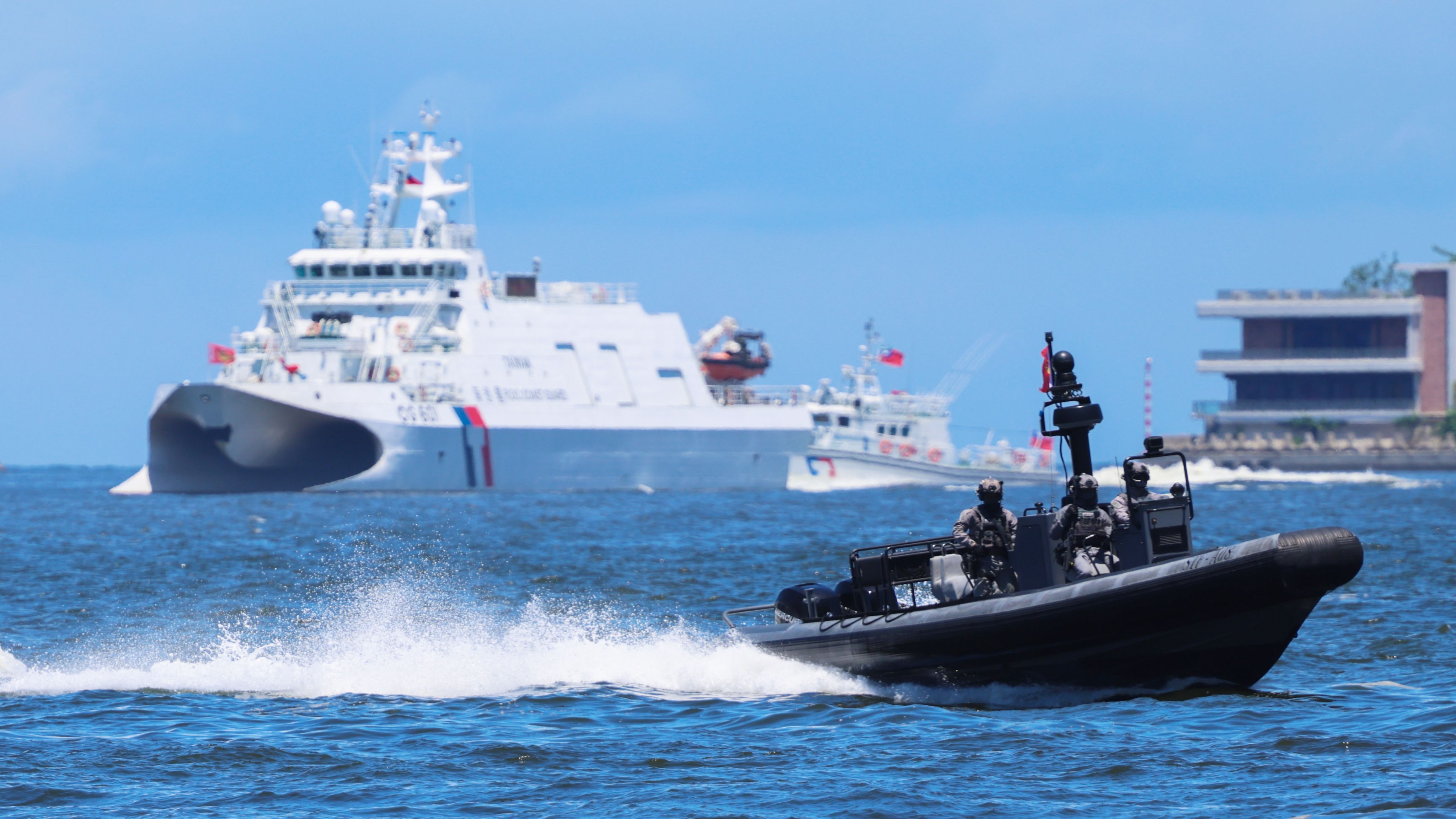
A report last month by the government-affiliated think tank Research Institute for Democracy, Society and Emerging Technology (DSET) warned that Taiwan was falling short in efforts to protect its subsea cables.
"The intelligence currently available regarding gray-zone activities overall fails to meet the threshold required for attribution, and thus further hinders response efforts and risks policy legitimacy," the report said.
Additionally, global norms limit states' options for dealing with offending vessels in international waters.
Hoo Chiew-Ping, co-founder and senior fellow of the East Asian International Relations Caucus, a network of researchers, said it is difficult for nations to protect subsea communication cables because no specific laws regulate gray-zone activities. "Regulations on subsea cables and marine policies are highly complex and deeply intertwined with geopolitical factors," Hoo told Nikkei.
"Most nations rely on territorial sea laws or exclusive economic zone legislation to regulate the laying and maintenance of undersea cables. But when those cables are cut or damaged, determining responsibility under domestic and international law becomes legally complex and highly challenging."
National Security Bureau Director-General Tsai Ming-yen warned earlier this year that international subsea cables and domestic communications infrastructure might be targeted by China, and said Taiwan would share relevant intelligence with like-minded countries to better grasp emerging trends in sabotage activities.
This week, President Lai Ching-te said the Executive Yuan is drafting a new law specifically covering subsea cables to protect Taiwan's national security and the "lifeline" of the island’s communications.


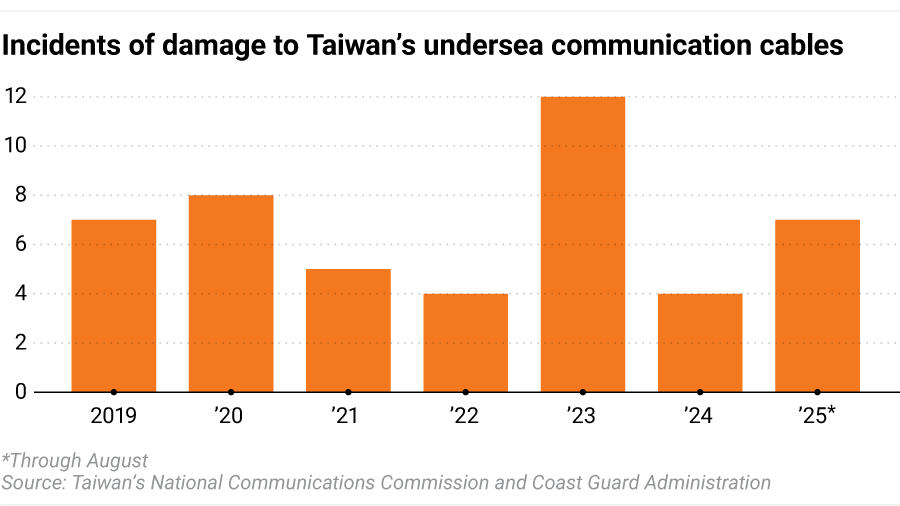
The safety of subsea cables is closely linked to economic and industrial security. Digital resilience has become one of Taiwan’s most critical security concerns, given its implications for the economy and communications.
Facing persistent geopolitical threats from China, the island is striving to maintain its role as a key cable hub, competing for new cable landing points to reinforce its position in the global AI supply chain.
But one executive said the subsea cable industry is growing concerned about the frequent incidents taking place around Taiwan.
"We've been talking about the cable damage incidents in Taiwan earlier this year. … The subsea cable is a weak spot for Taiwan. We all think it is a test of Taiwan's communication resilience, otherwise why are these incidents happening so frequently?" said the executive, who has worked in the industry for decades.
Another weak point in Taiwan’s subsea cable resilience lies in its cable-repairing capacity. Taiwan does not operate its own cable repair ships, meaning it relies on foreign technical support for all repairs. It can take weeks or even months just for a repair ship to arrive.
"There are a couple of ways to increase resilience," Chen Ta-Chen, nonresident fellow at DSET, told Nikkei. "The first is definitely to increase our own capability of cable repairing, but it needs industry support and can't fully count on the government, and second could be building more redundant subsea cables to avoid all communications being disrupted. Another key part is to upgrade our overall marine technologies to better detect abnormal activities."
Damage to Taiwan's subsea cables is rising, with ships crewed or funded by Chinese nationals linked to a number of cases.

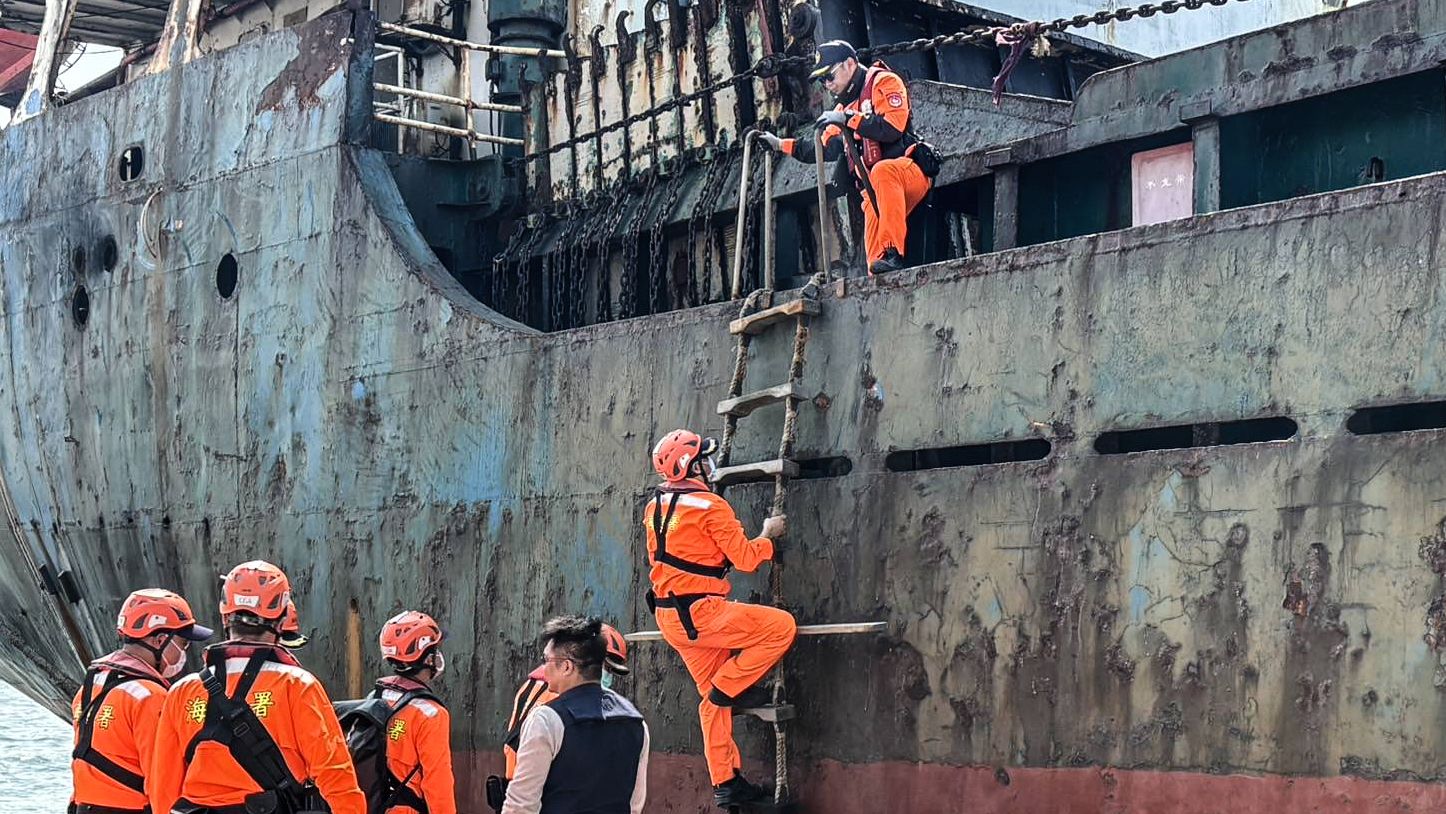
Chiueh, the former deputy digital minister, said Chunghwa Telecom has developed a system that sends alerts to any ships sailing near subsea cables connected to Taiwan to warn them to sail at slow speed.
The government is also collaborating with low Earth orbit satellite communication service providers like OneWeb, as well as upgrading existing microwave stations to enhance the island’s digital resilience, he said.
But subsea cables remain the most critical vehicle for communications, handling over 95% of such global traffic. Their production and installation have also become a battleground between Washington and Beijing, with China building up a complete supply chain network, from chips to cable-laying ships, in recent years. Geopolitical uncertainties had delayed or otherwise affected at least six international cables as of last year.
The U.S. Federal Communications Commission in July stepped up efforts to exclude Chinese influence from subsea cables, including banning companies that use Chinese technology and equipment from building subsea cables that connect to America and incentivizing the use of American repair and maintenance ships.
The EU’s top diplomat in Taipei, Lutz Guellner, told Nikkei that the two sides could learn from each other on maritime infrastructure and subsea cable resilience. "We see a lot of parallels between what happened in the Baltic Sea and around Taiwan," he said, referring to a case in late 2024 in which two cables in the Baltic were damaged, an incident some believe is linked to Russia.
"When cables are cut or damaged, determining responsibility under domestic and international law becomes ... highly challenging."
Hoo Chiew-Ping, co-founder,
East Asian International Relations Caucus

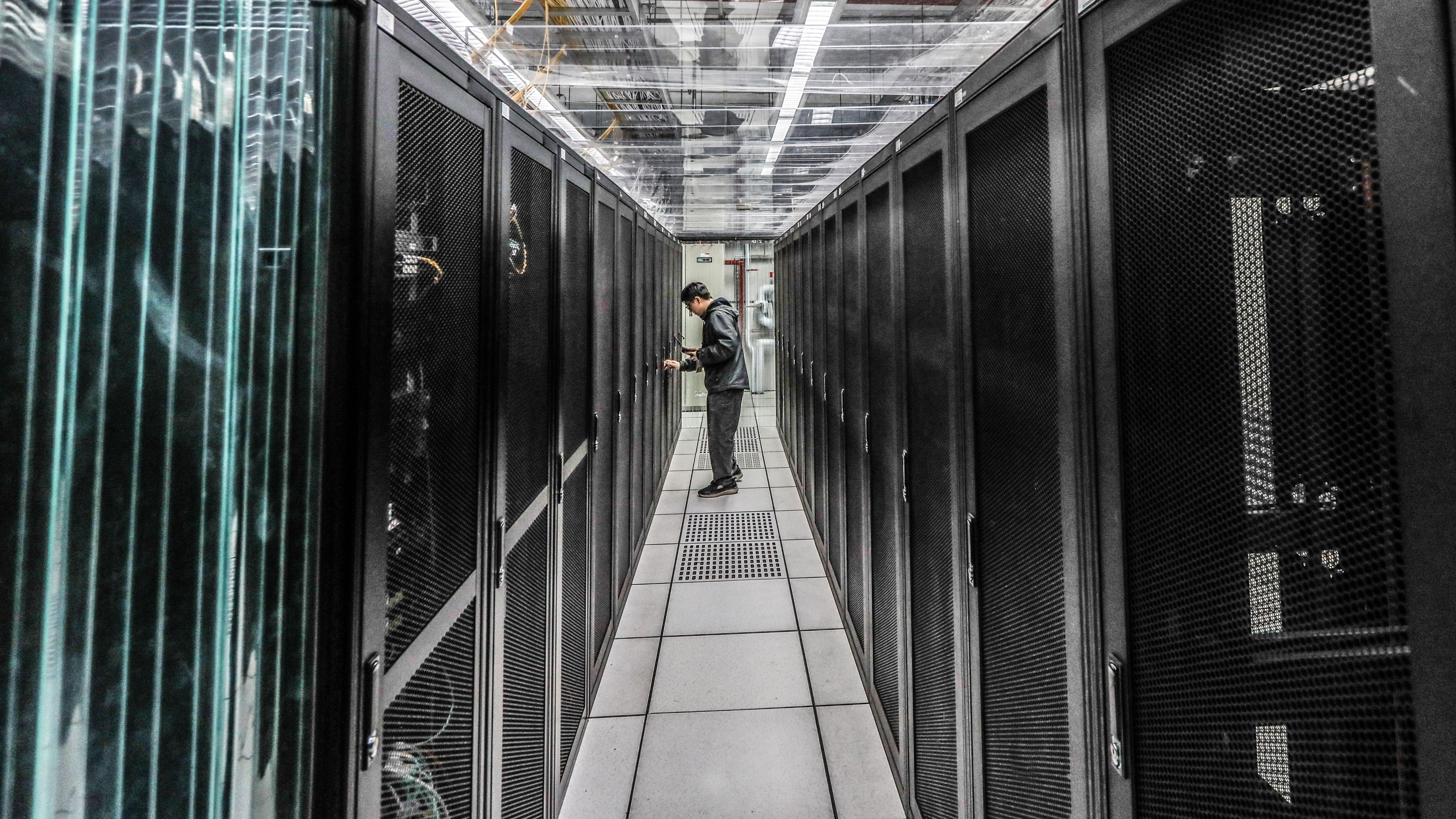
Meanwhile, the race for attracting new cables is heating up -- and becoming more complex.
The Southeast Asia-Japan Cable 2, a 10,500-kilometer subsea system linking Japan, Taiwan, Hong Kong, Vietnam, Thailand and Singapore and constructed by NEC, was completed in July and is now online. The project had been delayed for several years due to the pandemic and geopolitical tensions, as investors included both Meta from the U.S. and China Mobile, the country's top telecom operator. Taiwan's top carrier Chunghwa Telecom is also part of the consortium.
Deciding where to land a subsea cable has become one of the most critical issues in planning new projects.
One major subsea cable, the Google-backed TPU, is slated to come online this year. It lands at Taitung, on Taiwan's east coast, and will directly connect to Guam, a U.S. island territory in the Pacific Ocean, and the west coast of the U.S., bypassing the Taiwan Strait, where Beijing often sends ships and jets. Meta's ORCA subsea cable, linking Taiwan directly with the U.S., is also docking in Yilan on Taiwan's eastern coast. Another key subsea cable, Apricot, backed by a consortium of Chunghwa Telecom, NTT, Google and Meta, links Taiwan, Japan, the Philippines and Singapore while completely avoiding the South China Sea and its territorial disputes.
Securing more subsea cables and international landing points has become a way to enhance a location's strategic importance as major economies race to take the lead in AI computing -- an effort that entails building and linking massive data centers.

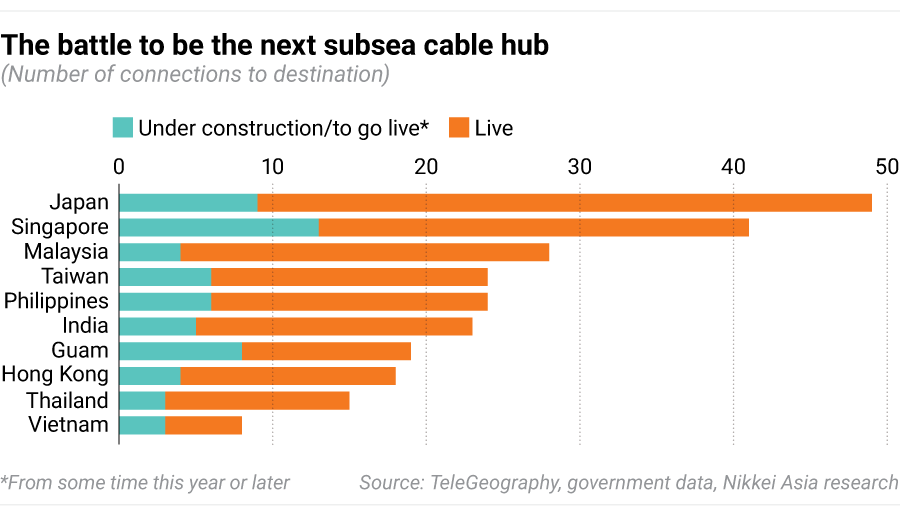
Singapore is the most popular subsea cable landing hub for Asia, with some 13 cables set to go live this year or under construction, followed by Japan with nine, according to Nikkei's analysis of TeleGeography data. Guam has bagged eight new international communication cable landings, as Western investors grow more concerned about connecting to Hong Kong, a traditional hot spot for such landings. India and the Philippines are also seeing increases in new subsea cable landings as their importance in the supply chain and data center buildup grows.
U.S.-China tensions have weakened Hong Kong's position as a data transfer hub, and the city has only four new subsea cables under construction or about to go online.
Taiwan is still in the fight and the government has pledged to expand its budget for building more ships and updating technologies to safeguard the vital digital lifeline.
The Coast Guard Administration has also proposed a special budget of 29.5 billion New Taiwan dollars ($972 million) to step up personnel training and to upgrade coast guard vessel specifications and technologies to safeguard Taiwan's maritime safety, including the security of its subsea cables.
"Right now, tensions between Beijing and Taipei are high. It's not wartime, but it's certainly not peacetime either," Hsieh, the Coast Guard Administration's deputy director general, told Nikkei. "We must remain alert to these threats, which is why we handle subsea cable incidents with the highest standards and protocols."